Showing posts with label hazards. Show all posts

November 16, 2018

Visualizing the Danger


As I watch the Usw Gasworkers videos of replacement workers’ hazardous errors and read the reports of the utility companies’ flawed operations and the failures of state and federal oversight, I am reminded of the 1937 Texas School Gas Explosion that killed more than 300 students, teachers and visitors.
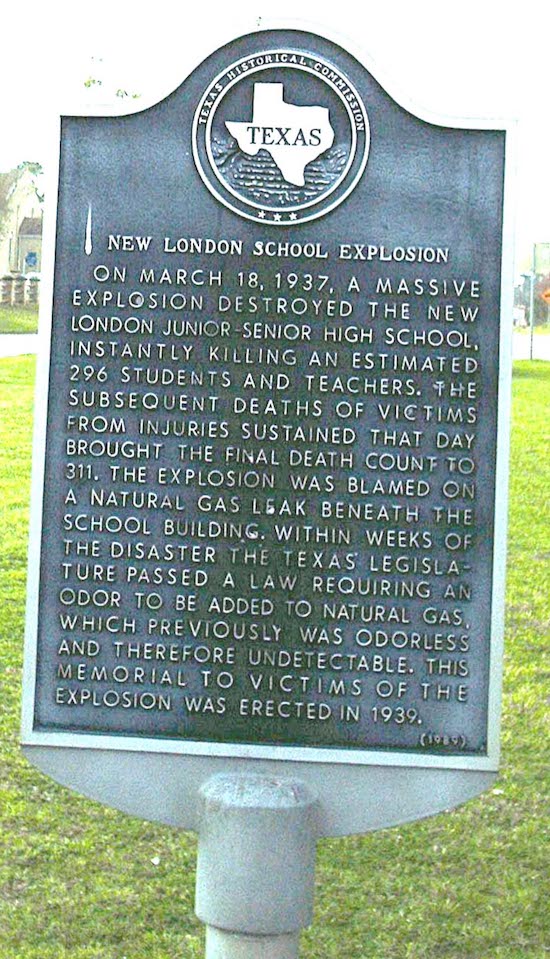

In 1937, school, town and oil company officials ignored warnings and agreed to look the other way as their unnecessary shortcuts and reckless indifference endangered a whole generation in a small East Texas town. Yet while the Court of Inquiry identified a series of design, building and operations problems and unheeded warnings, they named no one responsible. They concluded that school officials were just "average individuals, ignorant or indifferent to the need for precautionary measures, where they cannot, in their lack of knowledge, visualize a danger or a hazard." (Court of Inquiry, 1937.)


Today no one can claim that we cannot visualize the danger of our leaky gas infrastructure. Only those willfully blind are indifferent to the photos of explosions and fires in Merrimack Valley, the stories of death, injuries, devastation and trauma, and the system wide long-standing deficiencies such as those detailed in the November 1 USA Today article.


The danger grows by the day.  None of us can ignore the fact that thousands of leaks in Massachusetts communities have gone unrepaired for years while the utility companies charge customers millions of dollars for the lost gas.  


We have learned that old records and maps of the pipes and turn-off valves, if they exist, can be dangerously misleading and inaccurate. And many repairs do not stop the leaks. Even after ruptures and explosions are repaired, as in Prince George BC and in Merrimack Valley, the supply can be unreliable for a long time.


The truth is that, even if the utility companies had enough money to replace all the pipes, which they don’t, there are not enough field inspectors to oversee the quality of pipeline work. They do not have enough qualified personnel to do the work yet they continue to lock out experienced union gas workers. Nor are Governor Baker’s appointments to the Department of Public Utilities diligent in their oversight of the utility companies. The danger is heightened by state and federal safety regulations and standards that vary widely and often are not enforced.


No More Willful Blindness. The 1937 disaster resulted in a law requiring adding mercaptan as a warning odor to natural gas. As a result, in our own neighborhoods, we can smell the sulphurous “rotten eggs” when we walk our children to school or take our dogs around the block or go out to pick up the newspaper. Sometimes the odor is so strong we can smell the gas as we drive by, especially where holes have been drilled in the street pavement to vent the fumes instead of fixing a leak.


Inspirational Leadership. The growing grassroots organization Mothers Out Front has become a bold public advocate for policies and standards that respond to the threats of climate change and for accountability from government and corporate officials.


Breaking the silence. Rooted in a shared sense of unquenchable responsibility, Mothers Out Front state and community teams have built partnerships to fight for improved maintenance of the aging gas distribution system and to expose the health impacts of fracked gas all along the supply chain. Their ultimate goal is a swift complete and just transition away from fossil fuels and toward a future based on clean and renewable energy.


Mothers Out Front Newton applauds Newton Mayor Ruthanne Fuller and City Councilors who have taken an honest clear eyed look at the dangerous condition of our aging gas pipelines and the inadequacy of the gas companies’ operations. Their October 30 letter calls on Governor Baker and the MA Department of Public Utilities to live up to their statutory responsibility and act immediately to safeguard our community.


Use Less, Green the Rest. Mothers Out Front Newton is grateful to our City officials for speaking up for the safety and sustainability of our community and taking meaningful steps to promote clean renewable energy and energy efficiency in City programs and policies.

Lessons Learned. Indeed, we can all visualize a livable future and must take responsibility for achieving it.
~~~~~


Newton Pushes Governor On Gas Regulation After Merrimack Valley, 'We count on you to protect us from the risks associated with the use of natural gas,' say the Newton Mayor and City Councilors in a letter. Nov 1, 2018.

January 31, 2016

2016 Healthy Kids Heroeswww.healthy-kids.info logo.jpg

Every year, to mark the anniversary of the March 18, 1937 Texas School Explosion, I salute inspiring individuals who show extraordinary responsibility and inspirational leadership for school and community safety. They live and work by a standard of excellence and integrity — often in the face of denial, willful blindness, and indifference about hazards and unsafe conditions.


One lesson of the 1937 tragedy is that a safe quality environment depends on champions with an exceptional sense of responsibility. Another lesson is that we can’t take it for granted that local officials or elected representatives make community safety or health a priority. 

These four Heroes are inspiring for a combination of personal qualities and qualifications beyond credentials. Each, in his or her own way, promotes the values that build and continuously strengthen a culture of responsibility for safety and continuous improvement.
Rick Reibstein.jpeg

Todd and Rick are heroes because both have dedicated their lives and long careers to helping people make good decisions to prevent pollution and reduce environmental hazards in schools, workplaces and communities. As public agency officials, educators, mentors, and consultants, they have been innovative problem solvers in a variety of business, private, government and academic settings. They are experts at building relationships and trust with clients and communities.  
 JanePaddlingTrash.jpg
Jane Winn is a grassroots leader gifted at building community power to oppose pollution and advance sustainability. 

FB_IMG_1450830313189.jpg
Brooke Leifer is an inspiring young woman dedicated to using music to inspire people “to make the world a better place, a special place, a healthy place, to stop pollution."

December 03, 2013

Who Is Your 2014 Healthy Schools Hero?
Please post. Please forward.
Attention:  Science educators, STEM advocates, professionals in public health, school health, environmental health, facilities management, IAQ, IPM, health and safety, lab safety, school security, emergency and risk management, asthma educators, first responders, school administrators, nurses, advocates, parents and students.

Do you know someone whose sense of responsibility, inspirational leadership, and exemplary persistence and courage protects children from school hazards and unhealthy school conditions?

Send your hero's story, name, and email/phone # by February 1, 2014 to healthykids@rcn.com

The annual Healthy Kids Healthy Schools Hero Award was created as an annual opportunity to tell the story of the 1937 Texas School Explosion and to inspire leadership to protect children from the chemical hazards and unhealthy conditions in today's schools.  (HEROES 2004 - 2013)

March 18, 2014 is the 77th anniversary of the 1937 Texas School Explosion -- the worst school disaster in American history. Just minutes before the end of the school day, a gas explosion killed more than 300 people, mostly students. In their new state-of-the-art public school no expense had been spared except when it came to safety.

Lessons Learned. Lives Saved. The disaster resulted in a law that required adding a warning odor to natural gas, thus saving millions of lives all over the world. However, the false economies and short-sighted decisions that led to the 1937 explosion are still common in too many schools today. 

The Unfinished Legacy: Leadership for Excellence Needed.  The story of the 1937 Texas School Explosion needs to be part of our national legacy. Let's make March 18 an annual day to prioritize the values and technical skills we need to live safely with 21st century chemicals and technology.

Send your hero's story, name, and email/phone # by February 1, 2014 to healthykids@rcn.com.

- - -
*Photo (Ellie Goldberg, March 2005) 
The cenotaph, erected in 1939 is the memorial to victims of the 1937 school explosion. The sculptural block of Texas granite depicts twelve life-size figures, representing children coming to school, bringing gifts and handing in homework to two teachers. Around the inside of the base are the individual names of those who died.  The Egyptians defined a cenotaph as a symbolic tomb, honoring the dead but not containing the body. It is a sepulchral monument erected to commemorate a person or persons buried elsewhere.  
   

February 19, 2012

Some families lost more than one child. Photo: Ellie Goldberg, 2005
'Gone at 3:17: The Untold Story of the Worst School Disaster in American History.' David Brown and Michael Wereschagin will talk about their book and answer questions in a free session Saturday February 25 at 3 p.m. at the Andrew Carnegie Free Library & Music Hall, 300 Beechwood Ave., Carnegie.

At 3:17 p.m. on March 18, 1937, a natural gas leak beneath the London Junior-Senior High School in the oil boom town of New London, Texas, created a lethal mixture of gas and oxygen in the school’s basement. The odorless, colorless gas went undetected until the flip of an electrical switch triggered a colossal blast. 

The two-story school, one of the nation’s most modern, disintegrated, burying everyone under a vast pile of rubble and debris. More than 300 students and teachers were killed, and hundreds more were injured. As the seventy-fifth anniversary of the catastrophe approaches, it remains the deadliest school disaster in U.S. history. 

Few, however, know of this historic tragedy, and no book, until now, has chronicled the explosion, its cause, its victims, and the aftermath. Join us as authors David M. Brown and Michael Wereschagin present a talk and question and answer session about their powerful, timely and timeless book...
The authors found the situation 75 years ago in East Texas very much like what is going on in Western Pennsylvania today. Both areas became havens for energy exploration, and the urgency to extract resources -- oil and natural gas in Texas, Marcellus shale gas drilling in Pennsylvania -- is fierce.
Brown insists there's no political element in "Gone ... " but it can be read as "a darn good cautionary tale, that shows you exactly what can happen when you refuse to, or can't, see the dangers that can lie all around you," he says.

February 07, 2012


How Safe Is Your School?

Schools fill budget holes with fracking revenues http://www.stateline.org/live/details/story?contentId=597091


Public Schools vs. Shale Gas Pipelines  http://keeptapwatersafe.org/2012/01/31/public-schools-vs-shale-gas-pipelines/

Child Health Groups Call for Robust Assessment of Hydrofracking Health Impacts, www.healthyschools.org
Map of public school facilities in Marcellus Shale: P-12 public school facilities relying on private well water on the Marcellus Shale. This includes classroom buildings, administrative offices and bus garages.
The No Fracking Campaign http://chej.org/nofracking/
 ~ ~ ~ ~ ~ ~ ~ ~
(a) Safety: the condition of being protected against physical, social, spiritual, financial, political, emotional, occupational, psychological, educational consequences of failure, damage, error, accidents or harm.  (b) Safety can also be defined to be the control of recognized hazards to achieve an acceptable level of risk in the protection of people, possessions and environment. Quoted with permission.  --  Lynda K. Farrell, Executive Director, Pipeline Safety Coalition, www.pscoalition.org


"I have been in a lot of "events" in my 40 years, and the most dangerous of all safeties is the illusion of safety. ... We call this an operational setup for failure – very bad in risk management approaches." -- Richard B. Kuprewicz, President of Accufacts Inc.
~ ~ ~ ~ ~ ~ ~

Yes, it is painful to threaten the illusion of safety in a school or community and to talk about death and loss. The New London survivors did not talk about their pain for more than forty years.  They teach us that it is even more painful to live with a tragedy when opportunities to prevent loss were ignored or overlooked.

March 18, 2012 is the 75th anniversary of the 1937 Texas School Explosion.

December 20, 2011

Critical Exposure


On her first day at Roosevelt Senior H.S., Sabrina was shocked to find broken windows, leaky ceilings, and moldy class equipment. In October, Sabrina and her classmates began working with Critical Exposure to document the school's conditions and highlight the differences between Roosevelt and the renovations at many other D.C. public schools. She and her peers are now organizing students to hold city officials accountable for promises they made to begin modernizing the building this year... More: LINK
http://www.criticalexposure.org