Showing posts with label heroes. Show all posts

February 21, 2018

SAFEGUARDING CHILDREN AND COMMUNITIES

Every year, to mark the anniversary of the 1937 Texas School Explosion, I salute inspirational leaders who demonstrate an extraordinary sense of responsibility and commitment to the safety of children and their communities. Dr. Nordgaard is a 2018 Healthy Kids Hero.

Dr. Curt Nordgaard is one of the founders of the Massachusetts Health Professionals for Clean Energy, a grassroots organization working to raise awareness of the hazards of fracked gas and fossil fuel infrastructure and advocating for the transition to clean energy sources. Along with a rising tide of scientists and health professionals, they are calling for a comprehensive health impact assessment before new permits are issued and for changes to regulations and siting requirements so that public health is protected.

Dr. Nordgaard had already been giving presentations and speaking out about fracked gas hazards when Susan Lees learned about him. Lees was a member of the founding team of Mothers Out Front, the coordinator of the Massachusetts Mothers Out Front Pipeline Task Force and a member of the Environmental Justice Team.

Caring and Committed

Lees recognized that Dr. Nordgaard was dedicated to advocacy in spite of the demands of his pediatric practice and young family. She approached him to talk about their shared concern for communities impacted by fossil fuel hazards and industrial pollution as well as her interest in getting more health care professionals involved in efforts to stop new fossil fuel infrastructure projects as part of our transition away from fossil fuels.

Together they reached out to concerned physicians, nurses and other health professionals and recruited them to form Mass Health Care Providers Against Fracked Gas in May 2016 (later restructured as Massachusetts Health Professionals for Clean Energy). The group set their main goal — for the Commonwealth to conduct comprehensive health impact assessments before issuing permits for new gas infrastructure projects. They have been particularly concerned about the proposed Weymouth compressor station, a facility that would further pollute three communities on the South Shore including environmental justice communities.

By Sept 2016 the Massachusetts group had been in touch with another group, Concerned Health Professionals of NY, that had been working to report on the hazards of hydrofracking from the scientific and medical literature and to overcome the political obstacles to prioritizing public health.

The most engaged members of Massachusetts Health Professionals for Clean Energy started meeting with legislators, state officials and regulatory agencies. They have been testifying at legislative committee hearings, lobby days and demonstrations.

They teamed up with groups such as the Fore River Residents Against the Compressor Station that has a growing list of supporters and allies among local, state and national officials, community and environmental organizations and colleagues.They share data, model policies, and resources. See Fact Sheets and Resources.

Finding a Better Way

In October 2016 Mass Health Care Providers Against Fracked Gas submitted a Letter to state officials with a White Paper describing the Comprehensive Health Impact Assessment (CHIA) and its role in the review process for natural gas infrastructure projects. At a demonstration in front of a metering station in West Roxbury they called for a moratorium on major pipelines, new or under construction, “until the health of our patients, families, and communities can be adequately taken into account.” ( Press Release. )

Dr. Michael Cocchi and Dr. Nordgaard
Press Conference, Oct. 2016

Dr. Nordgaard and other opponents of the compressor station hired an outside environmental testing lab to test the air quality at and around the proposed site. Results showed high levels of pollutants including eight toxic pollutants at higher levels than MA Department of Environmental Protection guidelines, including repeatedly elevated levels of benzene. Dr. Nordgaard also collaborates on a research study to identify chemical contaminants in natural gas.

The goal is “to make sure something happens with the data” and to advocate for regulations and siting requirements that do a better job of protecting people.
_______________________

(Quincy Access Television, 1/2016.)
______________________

Gaining Momentum

An intensive advocacy campaign included media releases, demonstrations, social media and ongoing outreach and education to build relationships with community groups, legislatures, colleagues and professional groups throughout the state and across the country.

In July, 2017 Governor Baker finally halted the permitting process and called on state agencies to evaluate air pollution and public safety concerns.
“Even down to very low levels, air pollution is harmful for human health, and that's even below what's considered to be a safe standard today...” “The state should be doing something about what’s there already -- not adding more of those pollutants with a new station. “ (WGBH newscast 7/27/17t: State Reviewing Controversial Weymouth Natural Gas Compressor Plan.)

“In July, 2017 Gov. Charlie Baker notified Weymouth officials that he had directed state agencies to investigate issues that opponents have raised about the controversial project, including air pollution and public safety. Baker said the state will not issue any permits for the project until the assessment is complete.” (Doctor says natural gas from proposed compressor could ignite, Jessica Trufant, The Patriot Ledger, October 2017.)

The Power of Partnerships

January 30, 2018 In anticipation of the state’s 2018 air quality evaluation in 2018, Brita Lundberg MD, Regina LaRocque MD MPH, Susan Lees, Professor Nathan Phillips, PhD, and Jessica Wright organized “Natural Gas Infrastructure and Public Health: From Local to Global.” (Videos)

The conference was co-sponsored by Boston University School of Public Health, Massachusetts Medical Society, Massachusetts Association of Health Boards, Union of Concerned Scientists, Greater Boston Physicians for Social Responsibility, Health Care Without Harm, Massachusetts Health Professionals for Clean Energy, and Physicians for Policy Action.

February 2, 2018 Fifty-three Massachusetts Boards of Health signed a letter urging Governor Charlie Baker to require comprehensive health impact assessments for any new gas infrastructure, to measure the effects on the climate and human health.
It said that fracked gas infrastructure “increases health disparities, worsens public health, and makes poor use of our health care resources by potentially creating public health problems, instead of preventing them.” 
Some boards sent personal letters to the governor, citing specific concerns related to their community. The letter to the Governor and the list of local Boards of Health that signed it are here.

Advocacy for Clean Energy

Dr. Nordgaard’s work inspired other members of Massachusetts Health Professionals for Clean Energy to play active roles at the local and state level.

Dr. Brita Lundberg, an infectious diseases physician and a board member of Green Newton, was inspired by Dr Nordgaard’s March 2016 presentation at the local library about the intersection of fracked gas, air pollution, and climate change.
“We health care providers consider advocating for cleaner air and a response to climate change to be part of our professional responsibility as healthcare providers.”
Dr. Lundberg successfully initiated a resolution of the Environmental Health Committee of the Massachusetts Medical Society calling for a health impact assessment for new gas infrastructure.
Susan Racine MD (left), Brita Lundberg (center), 
Donna Dudik, RN, MNA (right) 
MA Statehouse, October 26, 2017

In her October 2017 testimony at the MA Department of Public Utilities and at the MA legislature’s Joint Committee on Telecommunications, Utilities and Energy, Dr. Lundberg cited resolutions by several professional medical associations.
“Because of these health concerns, the American Medical Association, the Massachusetts Medical Society, and the Massachusetts Nurses Association have passed resolutions supporting legislation to require comprehensive health impact assessments prior to the construction of natural gas infrastructure; the Mass Medical Society further demanded that the health impacts of existing natural gas infrastructure be studied; they were specifically interested in the health effects of gas leaks, which affects all of our communities.”
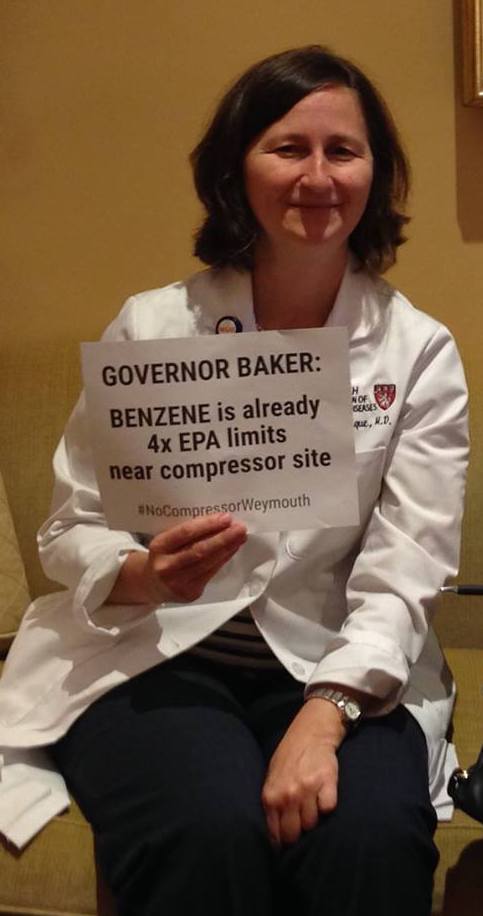
Dr. Regina LaRocque
Dr. Regina LaRocque is an Infectious Diseases specialist at the Massachusetts General Hospital and an Assistant Professor of Medicine at Harvard Medical School. She has a special interest in the impact of climate change on human health and the spread of infectious diseases.

In 2015 Dr. LaRocque attended the first meeting of the MA Interfaith Coalition for Climate Action whose organizers included Lisa Olney, a volunteer for the community group, Sustainable Wellesley. "Hearing Dr. Nordgaard speak about gas leaks and health hazards was a turning point. "I realized this was not just a policy debate, but a health issue," she said. "I decided I could apply my professional skills to my personal advocacy."

Dr. LaRocque got more involved as Sustainable Wellesley was raising awareness of the local gas leak problem. In 2017 she was elected to the Wellesley Natural Resources Commission and spoke at a community forum about gas and human health. Forum Video (Dr LaRocque’s presentation starts at 33:45 min.)

Raising the Alarm

Professional medical associations are raising the alarm and encouraging advocacy for clean energy and to expose the air and water pollution and environmental justice violations caused by gas and other fossil fuel infrastructure.

May 2016 the Health and Public Policy Committee of the American College of Physicians position paper
“We need to take action now to protect the health of our community’s most vulnerable members -- including our children, our seniors, people with chronic illnesses, and the poor -- because our climate is already changing and people are already being harmed.” -- Ann Intern Med. 2016 May 3. Climate Change and Health: A Position Paper of the American College of Physicians.

American Medical Association (2015). H-135.930 Protecting public health from natural gas infrastructure, Resolution 519, A-15.

Massachusetts Medical Society (2017). Protecting public health from natural gas infrastructure in Massachusetts, Resolution A-17 A-105.

Medical Society Consortium on Climate and Health (2017). Medical Alert! Climate Change is Harming our Health.

March 14, 2015

Let’s make March 18 an annual day to honor those whose extraordinary sense of responsibility and leadership protects students and staff from chemical hazards and unhealthy school conditions. Teach Safety. Teach Safely. Update our values and technical skills to live safely with 21st century chemicals and technology.

Hero 2015: A Wow ExperienceGregg Smith, Salt Lake City Schools Facility Services 

Read: Mike Matley, Custodian, Westborough Public Library, Westborough, MA

Read: Roger Young Roger Young and Associates, Andover, MA

MORE Hero STORIES
Janet Hurley 2013

 
Linda Stroud 2013
John Gann 2013
Aimee Code 2013
Dwight Peavey 2011
Ruth Breech 2009


September 23, 2013

HEROES for water, energy and food...  
GRACE Communications Foundation builds partnerships and develops innovative media strategies that increase public awareness of the relationships among food, water and energy systems. By mobilizing philanthropic resources and collaborating with like-minded non-profits and academic institutions, we educate consumers and advocate for policies that:

  • address the environmental and public health effects of industrial food systems
  • support the development of sustainable food distribution networks
  • result in common sense use of water resources for energy and food production
  • provide clean energy alternatives to conventional power systems
  • create and promote prevention techniques individuals and communities can use to improve their health

April 09, 2013

There is a HERO in your area. It could be you!

Countdown to National Healthy Schools Day April 30

HEROES understand that when it comes to making decisions that impact children, "no risk is acceptable if it is avoidable."  

HEROES are committed to building schools for occupancy by children recognizing that standards, building codes, and guidelines that are based on the average adult male or workplace regulations are not safe for children because children are not little adults.
  
HEROES serve as a resource and mentor to the school community, setting up in-house systems for community participation, health surveillance, and ongoing hazard identification and control.
  
HEROES support the rights of parents to be involved in the decisions that affect their children, acknowledging that without informed parents, there will never be enough experts or inspectors to ensure schools are the healthy places and safe havens they are supposed to be. 

HEROES educate community members, preparing them to exercise their special rights as parents, employees, patients, students and citizens.  

HEROES advocate for precautionary standards and protective measures as active members of building committees, school health advisory councils, site-based management boards, and environmental quality teams that set child safety standards and guidelines for school design, renovation, operations and maintenance, pest-proofing, lab safety, and all activities in and around the school.
Yes, it is painful to threaten the illusion of safety in a school or community and to talk about death and loss. The 1937 Texas School Explosion survivors did not talk about their painful experiences for more than forty years. Their stories clearly teach us that it is even more painful to live with a tragedy when opportunities to prevent loss were unseen or overlooked.

Inspiring Nominees Aimee Code and John Gann 

March 04, 2013

Announcing Healthy Schools Heroes 2013
Lessons of the 1937 Texas School Explosion
Contact: Ellie Goldberg, M.Ed.  617 965-9637

  
Every year to mark the anniversary of the March 18, 1937 Texas School Explosion, I salute Healthy Schools Heroes whose extraordinary sense of responsibility and leadership is dedicated to protecting students and staff from chemical hazards and unhealthy school conditions.
 
This year’s Healthy Schools Heroes are both widely admired as teachers, consultants and colleagues and respected for their proven ability to help schools achieve excellence in science, pest control, and environmental quality. By example, each Hero is an inspiration to break the silence about school hazards and bring the Lessons of the 1937 Texas School Explosion to today’s schools.  


Healthy Schools Heroes 2013


President, Science & Safety Consulting Service
Fayetteville, NC  

A force multiplier” Janet A. Hurley, MPA
 Extension Program Specialist II - School IPM
Texas A&M AgriLife Extension Service 

Safety is a priority. Like previous Healthy Schools Heroes, their unshakable priority is safety. 

Continuous Improvement. Their websites, newsletters, manuals, workshops and other resources testify to their values as well as their deep understanding of the daily decisions and challenges of managing classrooms, budgets, facility maintenance and operations and community relations. They are tireless in their commitment to giving people the knowledge and competencies to enable them to do a good job and a safe job. 
 
Partnerships. Each is remarkably gifted in building enduring personal and high value professional relationships in many roles at many levels. They partner with school district administrators, science teachers, parent groups, facility managers and custodians, academic and research institutions and professional organizations. Their approach to training and consulting strengthens multi-disciplinary, multi-agency, and organizational connections. 

Accountability. They also have been instrumental in achieving the public policy and legislative initiatives that provide accountability. Their expert guidance is repeatedly called on to help schools resolve hazardous chemistry lab conditions or pest control problems, to help schools meet codes and regulations, and even win national recognition.
 
Professional Development. Linda does assessments, training and ongoing professional development to help schools comply with the North Carolina’s Act to Implement Science Safety Measures in the Public Schools. It requires local boards of education to certify that schools are properly equipped with safety equipment and pre-service teachers are properly educated on safety measures. Janet works to promote high quality implementation of the Texas' School Integrated Pest Management (IPM) law. It requires all school districts to have an integrated pest management program (IPM) and a designated IPM Coordinator.  


No one is alone. They listen. They learn. They teach. They care. They keep in touch. No one is alone with a question or a problem because Linda Stroud and Janet Hurley are only a phone call or email away.  

Janet Hurley and Linda Stroud both emphasize the value of face-to-face conversations as the key to their effectiveness and their ongoing satisfaction in their work. They have thousands of grateful admirers who benefit from their inspiring leadership and reap the daily reward of safer children and safer schools.  

Healthy Schools Heroes 2013

Inspiring Nominees. Two additional inspiring professionals deserve special recognition for reaching out as advocates for precautionary action and best practices in schools.


~ 0 ~

Background  The Healthy Schools Hero Award is part of a campaign to make March 18 a day to remember the worst school disaster in American history, a gas explosion that killed more than 300 people, mostly students, just minutes before the end of the day in their new state-of-the-art public school.

A case study and cautionary tale. This story needs to be part of our national legacy because the flaws that led to the tragic explosion are still too common in many schools today – false economies in school design, building, and operations, unheeded warnings and indifference to hazards and precautionary measures.

The Unfinished Legacy  As a result of the disaster, a law was passed to require adding a warning odor to natural gas, thus saving millions of lives all over the world. However, other important recommendations of the 1937 Court of Inquiry are still needed in most 21st century schools -- technically trained administrators for modern school systems, regular inspections and education about hazards, and a comprehensive safety code.

Lessons of the 1937 Texas School Explosion is dedicated to making March 18 a day to honor the leaders who teach safely and teach safety and to inspire all schools to prioritize the values and technical skills necessary for living safely with 21st century chemicals and technology.

For more information contact: Ellie Goldberg, ellie.goldberg@healthy-kids.info

November 26, 2012

Who Is Your 2013 Healthy Schools Hero?
Please post. Please forward

For Immediate Release
Contact: Ellie Goldberg, M.Ed., healthykids@rcn.com 
Attn:  Science educators, STEM advocates, professionals in public health, school health, environmental health, facilities management, IAQ, IPM, health and safety, lab safety, school security, emergency and risk management, asthma educators, first responders, school administrators, nurses, advocates, parents and students.

Do you know someone whose sense of responsibility, inspirational leadership, and exemplary persistence and courage protects children from school hazards and unhealthy school conditions?

Send your hero's name, email/phone #,
and your hero's story by February 10, 2013
to Ellie Goldberg at healthykids@rcn.com
 
Lessons Learned. Lives Saved.  

The Healthy Kids Healthy Schools Hero Award was created as an annual opportunity to tell the story of the 1937 Texas School Explosion and to inspire leadership and partnerships to protect children from the chemical hazards and unhealthy conditions in today's schools. (HEROES 2012 - 2004)

March 18, 2013 is the 76th anniversary of the 1937 Texas School Explosion.  The 1937 Texas School Explosion was the worst school disaster in American history. It was a gas explosion that killed more than 300 people, mostly students, just minutes before the end of the day in their new state-of-the-art public school. No expense had been spared except when it came to safety.

The story of the 1937 Texas School Explosion needs to be part of our national legacy because the decision-making that led to the 1937 explosion is the same type of decision-making in too many schools today.  The story can inspire us to break the silence about school hazards and to prioritize the values and technical skills we need to live safely with 21st century chemicals and technology.
Send your 2013 hero's name, contact information, and your hero's story by February 10, 2013 to Ellie Goldberg at healthykids@rcn.com
- 0 -
Photo (E. Goldberg,2005): Cenotaph Commemorates Memory of Those Who Died in School Blast March 18, 1937  http://www.newlondonschool.org/Cenotaph.htm