Showing posts with label pollution. Show all posts

February 21, 2018

SAFEGUARDING CHILDREN AND COMMUNITIES

Every year, to mark the anniversary of the 1937 Texas School Explosion, I salute inspirational leaders who demonstrate an extraordinary sense of responsibility and commitment to the safety of children and their communities. Dr. Nordgaard is a 2018 Healthy Kids Hero.

Dr. Curt Nordgaard is one of the founders of the Massachusetts Health Professionals for Clean Energy, a grassroots organization working to raise awareness of the hazards of fracked gas and fossil fuel infrastructure and advocating for the transition to clean energy sources. Along with a rising tide of scientists and health professionals, they are calling for a comprehensive health impact assessment before new permits are issued and for changes to regulations and siting requirements so that public health is protected.

Dr. Nordgaard had already been giving presentations and speaking out about fracked gas hazards when Susan Lees learned about him. Lees was a member of the founding team of Mothers Out Front, the coordinator of the Massachusetts Mothers Out Front Pipeline Task Force and a member of the Environmental Justice Team.

Caring and Committed

Lees recognized that Dr. Nordgaard was dedicated to advocacy in spite of the demands of his pediatric practice and young family. She approached him to talk about their shared concern for communities impacted by fossil fuel hazards and industrial pollution as well as her interest in getting more health care professionals involved in efforts to stop new fossil fuel infrastructure projects as part of our transition away from fossil fuels.

Together they reached out to concerned physicians, nurses and other health professionals and recruited them to form Mass Health Care Providers Against Fracked Gas in May 2016 (later restructured as Massachusetts Health Professionals for Clean Energy). The group set their main goal — for the Commonwealth to conduct comprehensive health impact assessments before issuing permits for new gas infrastructure projects. They have been particularly concerned about the proposed Weymouth compressor station, a facility that would further pollute three communities on the South Shore including environmental justice communities.

By Sept 2016 the Massachusetts group had been in touch with another group, Concerned Health Professionals of NY, that had been working to report on the hazards of hydrofracking from the scientific and medical literature and to overcome the political obstacles to prioritizing public health.

The most engaged members of Massachusetts Health Professionals for Clean Energy started meeting with legislators, state officials and regulatory agencies. They have been testifying at legislative committee hearings, lobby days and demonstrations.

They teamed up with groups such as the Fore River Residents Against the Compressor Station that has a growing list of supporters and allies among local, state and national officials, community and environmental organizations and colleagues.They share data, model policies, and resources. See Fact Sheets and Resources.

Finding a Better Way

In October 2016 Mass Health Care Providers Against Fracked Gas submitted a Letter to state officials with a White Paper describing the Comprehensive Health Impact Assessment (CHIA) and its role in the review process for natural gas infrastructure projects. At a demonstration in front of a metering station in West Roxbury they called for a moratorium on major pipelines, new or under construction, “until the health of our patients, families, and communities can be adequately taken into account.” ( Press Release. )

Dr. Michael Cocchi and Dr. Nordgaard
Press Conference, Oct. 2016

Dr. Nordgaard and other opponents of the compressor station hired an outside environmental testing lab to test the air quality at and around the proposed site. Results showed high levels of pollutants including eight toxic pollutants at higher levels than MA Department of Environmental Protection guidelines, including repeatedly elevated levels of benzene. Dr. Nordgaard also collaborates on a research study to identify chemical contaminants in natural gas.

The goal is “to make sure something happens with the data” and to advocate for regulations and siting requirements that do a better job of protecting people.
_______________________

(Quincy Access Television, 1/2016.)
______________________

Gaining Momentum

An intensive advocacy campaign included media releases, demonstrations, social media and ongoing outreach and education to build relationships with community groups, legislatures, colleagues and professional groups throughout the state and across the country.

In July, 2017 Governor Baker finally halted the permitting process and called on state agencies to evaluate air pollution and public safety concerns.
“Even down to very low levels, air pollution is harmful for human health, and that's even below what's considered to be a safe standard today...” “The state should be doing something about what’s there already -- not adding more of those pollutants with a new station. “ (WGBH newscast 7/27/17t: State Reviewing Controversial Weymouth Natural Gas Compressor Plan.)

“In July, 2017 Gov. Charlie Baker notified Weymouth officials that he had directed state agencies to investigate issues that opponents have raised about the controversial project, including air pollution and public safety. Baker said the state will not issue any permits for the project until the assessment is complete.” (Doctor says natural gas from proposed compressor could ignite, Jessica Trufant, The Patriot Ledger, October 2017.)

The Power of Partnerships

January 30, 2018 In anticipation of the state’s 2018 air quality evaluation in 2018, Brita Lundberg MD, Regina LaRocque MD MPH, Susan Lees, Professor Nathan Phillips, PhD, and Jessica Wright organized “Natural Gas Infrastructure and Public Health: From Local to Global.” (Videos)

The conference was co-sponsored by Boston University School of Public Health, Massachusetts Medical Society, Massachusetts Association of Health Boards, Union of Concerned Scientists, Greater Boston Physicians for Social Responsibility, Health Care Without Harm, Massachusetts Health Professionals for Clean Energy, and Physicians for Policy Action.

February 2, 2018 Fifty-three Massachusetts Boards of Health signed a letter urging Governor Charlie Baker to require comprehensive health impact assessments for any new gas infrastructure, to measure the effects on the climate and human health.
It said that fracked gas infrastructure “increases health disparities, worsens public health, and makes poor use of our health care resources by potentially creating public health problems, instead of preventing them.” 
Some boards sent personal letters to the governor, citing specific concerns related to their community. The letter to the Governor and the list of local Boards of Health that signed it are here.

Advocacy for Clean Energy

Dr. Nordgaard’s work inspired other members of Massachusetts Health Professionals for Clean Energy to play active roles at the local and state level.

Dr. Brita Lundberg, an infectious diseases physician and a board member of Green Newton, was inspired by Dr Nordgaard’s March 2016 presentation at the local library about the intersection of fracked gas, air pollution, and climate change.
“We health care providers consider advocating for cleaner air and a response to climate change to be part of our professional responsibility as healthcare providers.”
Dr. Lundberg successfully initiated a resolution of the Environmental Health Committee of the Massachusetts Medical Society calling for a health impact assessment for new gas infrastructure.
Susan Racine MD (left), Brita Lundberg (center), 
Donna Dudik, RN, MNA (right) 
MA Statehouse, October 26, 2017

In her October 2017 testimony at the MA Department of Public Utilities and at the MA legislature’s Joint Committee on Telecommunications, Utilities and Energy, Dr. Lundberg cited resolutions by several professional medical associations.
“Because of these health concerns, the American Medical Association, the Massachusetts Medical Society, and the Massachusetts Nurses Association have passed resolutions supporting legislation to require comprehensive health impact assessments prior to the construction of natural gas infrastructure; the Mass Medical Society further demanded that the health impacts of existing natural gas infrastructure be studied; they were specifically interested in the health effects of gas leaks, which affects all of our communities.”
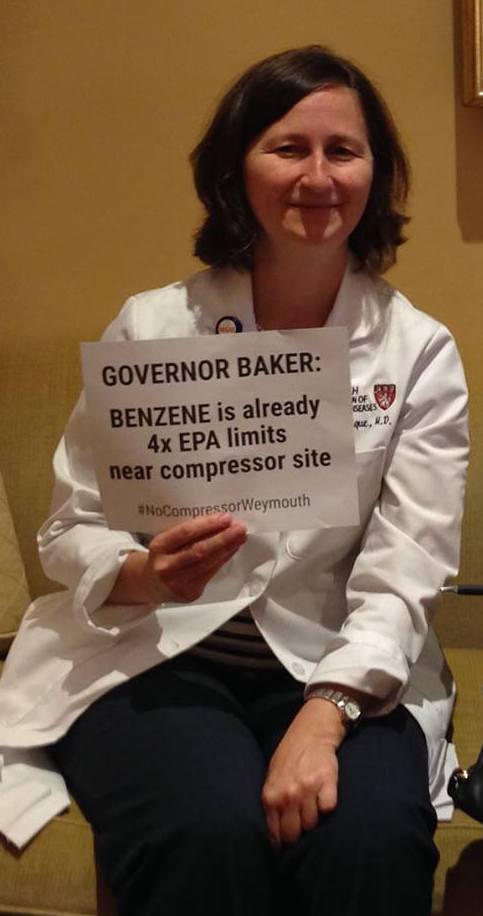
Dr. Regina LaRocque
Dr. Regina LaRocque is an Infectious Diseases specialist at the Massachusetts General Hospital and an Assistant Professor of Medicine at Harvard Medical School. She has a special interest in the impact of climate change on human health and the spread of infectious diseases.

In 2015 Dr. LaRocque attended the first meeting of the MA Interfaith Coalition for Climate Action whose organizers included Lisa Olney, a volunteer for the community group, Sustainable Wellesley. "Hearing Dr. Nordgaard speak about gas leaks and health hazards was a turning point. "I realized this was not just a policy debate, but a health issue," she said. "I decided I could apply my professional skills to my personal advocacy."

Dr. LaRocque got more involved as Sustainable Wellesley was raising awareness of the local gas leak problem. In 2017 she was elected to the Wellesley Natural Resources Commission and spoke at a community forum about gas and human health. Forum Video (Dr LaRocque’s presentation starts at 33:45 min.)

Raising the Alarm

Professional medical associations are raising the alarm and encouraging advocacy for clean energy and to expose the air and water pollution and environmental justice violations caused by gas and other fossil fuel infrastructure.

May 2016 the Health and Public Policy Committee of the American College of Physicians position paper
“We need to take action now to protect the health of our community’s most vulnerable members -- including our children, our seniors, people with chronic illnesses, and the poor -- because our climate is already changing and people are already being harmed.” -- Ann Intern Med. 2016 May 3. Climate Change and Health: A Position Paper of the American College of Physicians.

American Medical Association (2015). H-135.930 Protecting public health from natural gas infrastructure, Resolution 519, A-15.

Massachusetts Medical Society (2017). Protecting public health from natural gas infrastructure in Massachusetts, Resolution A-17 A-105.

Medical Society Consortium on Climate and Health (2017). Medical Alert! Climate Change is Harming our Health.

January 10, 2016

Early Warnings, Late Lessons 

One lesson of the 1937 School Explosion story is that we can’t take it for granted that local officials and elected representatives make community safety or health a priority.

Lessons Lost, Cutting Costs. 
Flint, Michigan 2016

The poisoning of Flint’s water supply is another sad illustration of what happens when cutting costs comes before protecting the public. 


To save money, the Governor's appointed city manager switched the public water supply to the long-polluted Flint River rather than from Detroit’s system. But the river’s water was high in salt, which helped corrode Flint’s aging pipes, leaching high amounts of lead into the water supply. Months of a poisoned water supply has caused serious acute, ongoing and long term damage to the residents, especially brain damage to the lead poisoned children. 

To make matters worse, officials knew that the water was bad but there was denial and dismissal of residents concerns for over a year. More:  What Did the Governor Know About Flint's Water, and When Did He Know It? The Atlantic, January 9, 2016
  
Bad Decisions, Broken Promises: A Timeline of the Flint Water Crisis
ABC News, Timeline of the Water Crisis

Failures to follow law caused Flint water crisis

__________________________

Lessons Lost, Cutting Costs.  
New London TX 1937

March 18, 1937, a gas explosion killed more than 300 students, teachers and visitors while they were in the supposed safe haven of a new state-of-the-art public school. 

To save money the school board substituted a gas system for the steam system. They had ignored the architects' warnings that the building had not been designed to vent gas fumes. Then, the school board decided to hook-up to a free residue gas line while school and oil company officials agreed to look the other way.

An inquiry into the disaster reported other design, building and operations problems and unheeded warnings. Even though the gas had no odor, there were reports that students had headaches and burning eyes from gas fumes in their classrooms. One account describes students sitting in a classroom with jackets on and windows open to vent the fumes.

On March 18, thirteen minutes before school dismissal, a shop teacher flipped a switch to turn on a power sander and a spark set off a gas explosion.


Following the disaster, a law was passed required an odor in natural gas. Other recommended school safety measures have yet to be implemented in most communities.

Read more: The Unfinished Legacy: What was the 1937 Texas School Explosion?

March 18, 2009

Hero 2009
Ruth Breech

Every year, to mark the anniversary of the March 18, 1937 Texas School Explosion, I name a Healthy Kids Hero who demonstrates extraordinary responsibility and inspirational leadership for safety.

The 2009 Healthy Kids Hero Award winner is Ruth Breech, Program Director at Global Community Monitor in El Cerrito, CA.  Ruth Breech was nominated by Peter Fugazzotto, Director of Oceans and Communities, for her work to protect school children in Addyston, Ohio from the hazards of toxic industrial pollution.

Described in the media as a "tenacious, high-energy community activist," Breech is motivated to "tell the untold story" of the people who suffer in silence in "fenceline" communities such as Addyston, OH. 

Breech's leadership shows how individuals and community groups can work together to break the silence about hazards and stimulate government agencies to take necessary action.

Like the Healthy Kids Heroes before her, I hope Ruth Breech's story can inspire others to break the silence about environmental health hazards and to take action to save lives where chemical hazards and other unhealthy conditions in school and communities are routinely ignored.

Once upon a time in Addyston, Ohio...

From 2003 to 2007 Ruth Breech was an organizer with Ohio Citizen Action, www.ohiocitizen.org, an environmental watchdog organization that runs anti-pollution Good Neighbor Campaigns.  Ohio Citizen Action uses the power of community organizing to convince major industries to prevent pollution at their facilities.

In his nomination, Fugazzotto wrote: "Ruth led the community fight in Addyston, Ohio that resulted in reducing the dangerous exposure to toxic chemicals from Lanxess Plastics, a 130-acre chemical plant directly across from an elementary school.  Her work helped inform the recent USA Today investigative series "Toxic Air and America's Schools" focusing on toxic pollution from factories creating hazards for school children...She's an inspiration." 

Ruth Breech, now at Global Community Monitor (GCM) in El Cerrito, CA , shares her experience and expertise with communities across the country.  In her first year at GCM, she assisted in training 1,000 community members and mothers to fight back for their health and future generations, especially low income residents and people of color in communities that suffer from an unfair burden of pollution.

Breaking the silence.


In September, 2004, Breech began to visit Addyston two to three times a week with a cadre of canvassers ringing doorbells and asking residents what it was like living in such close proximity with the plastics plant.  

The residents talked about the persistent odors from the plant, the dust that collected on their cars, and the large number of illnesses such as asthma and cancer in the neighborhood.

For most residents it was the first time anyone had asked them about whether or not the odors from the plant were bothering them and it got them talking among themselves. Some residents near the plant were so concerned that they were trained to conduct their own environmental monitoring with air sampling "buckets" made from 5 gallon plastic buckets, plastic liners, and sealed lids with a small air pump to create a vacuum.  Their air monitoring showed serious air quality problems.

"Ruth Breech did an amazing job of helping neighbors organize and meet every week," said Executive Director Sandy Buchanan, quoted in the article "Addyston, Ohio: The Plastics Plant Next Door" by Steve Lerner, online at The Collaborative on Health and the Environment (CHE).  (www.healthandenvironment.org)

Addyston is a working-class factory town on the banks of the Ohio River 12 miles from downtown Cincinnati in the Ohio/Kentucky/Indiana tri-state area.  Addyston is a company town where 97 percent of the tax revenues come from the Lanxess plant.  Most residents have family members or friends who work at the plant.  Speaking out against Lanxess was seen as threatening to local jobs and economy.

"It is a culture where it is not accepted to rock the boat," said Breech.

Advocacy in Action

"She went into a highly charged environment in a small company town where the mayor was not happy with an outside group raising issues about air quality and she did not back down. Through canvassing and walking-and-talking tours through Addyston, Breech continued to find new people willing to speak out and keep pressure on Lanxess to clean up its act, " said Buchanan.

Breech worked with the community to learn about the health risks of the chemicals they found and to ask the hard questions they needed to ask.

She was not trying to close the plant. "We want them to stay here. We don't want them to shut down. That is not our intention. We are here to clean them up. We want them to be good neighbors for a very long time," she says.

Over 26,000 members of Ohio Citizen Action
sent handwritten letters and petitions urging Lanxess Plastics managers to work with neighbors to cut emissions and make their community safer and healthier. The fact that so many people from around the region got involved made a big difference. Read more about the campaign at http://www.ohiocitizen.org/campaigns/bayer/bayer.html

Reacting to community health concerns and community sampling data about the impact of emissions from Lanxess, the Hamilton County Department of Environmental Services installed air monitoring equipment on the roof of Meredith Hitchens Elementary School.

On December 6, 2005, after hearing results from the Ohio Environmental Protection Agency's (OEPA) seven month monitoring of air quality, Three Rivers School District officials closed the Meredith Hitchens elementary school attended by 370 preschool to first grade students.  On June 14, 2006, The U.S. EPA issued an 8-page Notice of Violation against Lanxess citing air pollution problems, leaks in the chemical piping system, and asking questions about wastewater discharge. 

As a result of Ohio Citizen Action's campaign, Lanxess committed to invest $1 million to reduce butadiene emissions, another $1.5 million to reduce accidents, appointed a new plant manager and opened positive dialogue with the community and parents.

"Most Americans expect that the government will protect them from chemical releases [such as those at Lanxess],"  said Hagit Limor, one of the first reporters to report on the Lanxess pollution.  "But what emerged as I did these stories was that government officials do not lead on these issues but rather need to be led."

"It has been left up to grassroots groups and the media to shine a light on chemical pollution problems. As a result, a lot of corporations that are responsible for a lot of pollution are flying under the radar...and that leaves the population at risk," she says.