Showing posts with label 1937 Texas School Explosion. Show all posts

February 24, 2020

Hero 2020 Carl Weimer: The Right Man at the Right Time in the Right Place

The Healthy Kids Hero Award

Every year, to mark the anniversary of the March 18, 1937 Texas School Explosion, I salute someone who demonstrates an extraordinary sense of responsibility and commitment to the safety of children and their communities. 

The Healthy Kids Hero Award is an annual opportunity to remember the 1937 TX tragedy and to inspire others to take leadership for public safety, especially where gas pipelines, compressor stations, and other hazardous fossil fuel projects contaminate air and drinking water and put schools, families, and whole communities at risk for deadly explosions and fires. (Heroes 2004 - 2019)

Carl Weimer, Executive Director of the Pipeline Safety Trust (PST), is the 2020 Hero.

Over his long career Weimer has earned multiple awards from colleagues, community leaders, government officials, and other admirers including the 2015 White House for being the most effective advocate for improving the safety of nation’s vast network of gas and oil pipelines.

Courage, Credibility, Community

As important as all his accolades are, Weimer deserves the highest recognition and gratitude of the public and local governments for legitimizing the role of communities in the regulatory process. And, in his role as public interest watchdog, he achieves a high level of trust and credibility as he continuously champions a high standard for transparency in the pipeline industry and the regulatory agencies.

One reason for Weimer’s effectiveness is his remarkable ability to humanize the deadly consequences of the pipeline industry’s ugly history, especially its repeated incidents of criminal negligence and poor management. He firmly believes that citizens should be able to trust that their government is pro-actively working to prevent pipeline hazards.


November 16, 2018

Visualizing the Danger


As I watch the Usw Gasworkers videos of replacement workers’ hazardous errors and read the reports of the utility companies’ flawed operations and the failures of state and federal oversight, I am reminded of the 1937 Texas School Gas Explosion that killed more than 300 students, teachers and visitors.


In 1937, school, town and oil company officials ignored warnings and agreed to look the other way as their unnecessary shortcuts and reckless indifference endangered a whole generation in a small East Texas town. Yet while the Court of Inquiry identified a series of design, building and operations problems and unheeded warnings, they named no one responsible. They concluded that school officials were just "average individuals, ignorant or indifferent to the need for precautionary measures, where they cannot, in their lack of knowledge, visualize a danger or a hazard." (Court of Inquiry, 1937.)


Today no one can claim that we cannot visualize the danger of our leaky gas infrastructure. Only those willfully blind are indifferent to the photos of explosions and fires in Merrimack Valley, the stories of death, injuries, devastation and trauma, and the system wide long-standing deficiencies such as those detailed in the November 1 USA Today article.


The danger grows by the day.  None of us can ignore the fact that thousands of leaks in Massachusetts communities have gone unrepaired for years while the utility companies charge customers millions of dollars for the lost gas.  


We have learned that old records and maps of the pipes and turn-off valves, if they exist, can be dangerously misleading and inaccurate. And many repairs do not stop the leaks. Even after ruptures and explosions are repaired, as in Prince George BC and in Merrimack Valley, the supply can be unreliable for a long time.


The truth is that, even if the utility companies had enough money to replace all the pipes, which they don’t, there are not enough field inspectors to oversee the quality of pipeline work. They do not have enough qualified personnel to do the work yet they continue to lock out experienced union gas workers. Nor are Governor Baker’s appointments to the Department of Public Utilities diligent in their oversight of the utility companies. The danger is heightened by state and federal safety regulations and standards that vary widely and often are not enforced.


No More Willful Blindness. The 1937 disaster resulted in a law requiring adding mercaptan as a warning odor to natural gas. As a result, in our own neighborhoods, we can smell the sulphurous “rotten eggs” when we walk our children to school or take our dogs around the block or go out to pick up the newspaper. Sometimes the odor is so strong we can smell the gas as we drive by, especially where holes have been drilled in the street pavement to vent the fumes instead of fixing a leak.


Inspirational Leadership. The growing grassroots organization Mothers Out Front has become a bold public advocate for policies and standards that respond to the threats of climate change and for accountability from government and corporate officials.


Breaking the silence. Rooted in a shared sense of unquenchable responsibility, Mothers Out Front state and community teams have built partnerships to fight for improved maintenance of the aging gas distribution system and to expose the health impacts of fracked gas all along the supply chain. Their ultimate goal is a swift complete and just transition away from fossil fuels and toward a future based on clean and renewable energy.


Mothers Out Front Newton applauds Newton Mayor Ruthanne Fuller and City Councilors who have taken an honest clear eyed look at the dangerous condition of our aging gas pipelines and the inadequacy of the gas companies’ operations. Their October 30 letter calls on Governor Baker and the MA Department of Public Utilities to live up to their statutory responsibility and act immediately to safeguard our community.


Use Less, Green the Rest. Mothers Out Front Newton is grateful to our City officials for speaking up for the safety and sustainability of our community and taking meaningful steps to promote clean renewable energy and energy efficiency in City programs and policies.

Lessons Learned. Indeed, we can all visualize a livable future and must take responsibility for achieving it.
~~~~~


Newton Pushes Governor On Gas Regulation After Merrimack Valley, 'We count on you to protect us from the risks associated with the use of natural gas,' say the Newton Mayor and City Councilors in a letter. Nov 1, 2018.

February 01, 2017

Healthy Kids Hero 2017 Audrey Schulman, Cambridge MA


For Release February 2, 2017
Contact: Ellie Goldberg, ellie.goldberg@healthy-kids.info
Blog: ​LESSONS OF THE 1937 TX SCHOOL EXPLOSION​ 

Every year, to mark the anniversary of the March 18, 1937 Texas School Explosion, I salute a hero for inspirational leadership and a commitment to the safety of children and their communities.

The Hero Award was created as an annual opportunity to remember the 1937 tragedy — a gas explosion that killed more than 300 people, mostly students, in their new state-of-the-art public school where no expense had been spared except when it came to safety.
​
One lesson the 1937 tragedy is that a safe quality environment depends on champions with an extraordinary sense of responsibility. We can't take it for granted that elected officials make community safety or health a priority.


Audrey Schulman is the 2017 Hero because of her strategic advocacy and creative leadership confronting the threat of Climate Change. She is raising awareness of methane leaks from old pipelines, engaging ever widening circles of allies and partners, and achieving major advances in utility company cooperation and infrastructure best practices.
“​The federal government won’t take action 
on a clean energy future, but we can.“

​Creating a Culture of Responsibility. 
Schulman is a master at connecting the dots from data to public policy. Policy makers, advocates and utility companies who share her sense of urgency about reducing methane emissions rely on Schulman for accurate data, beautifully designed resources, and trusted relationships.

“Audrey took the results from our 2013 Boston gas study to the next level by meticulously mapping leaks from hard-to-access records in over 200 cities and towns in the Commonwealth. Along the way she has engaged and activated communities to create a groundswell of public support to save ratepayer money, our urban trees, air quality and our climate. Audrey is a hero for all these reasons but most of all for our children's health and their future.” — Boston University Professor Nathan Phillips. 

"Audrey Schulman has diligently worked to reduce energy bills in houses of worship, plug holes in leaking gas lines and make our state's government work better. She's incredibly thorough, creative, persistent and a great contributor to the environmental movement.” — Joel Wool, Advocate for Energy and Environment at Clean Water Action/MA

​... Schulman's efforts will have implications for the efficient and quality management of gas pipelines nationwide and for shaping legislation for regulating utilities. The results will save municipalities, utilities and ratepayers the huge cost of lost gas, avoid disruptive and duplicative road work, lower the health and life-threatening safety risks of neighborhood gas leaks, and reduce the threat of climate change.

Contact: Ellie Goldberg, ellie.goldberg@healthy-kids.info

October 16, 2015

What's That Smell? How Natural Gas Is Odorized For Safety

• Oct 8, 2015

In 1937, a natural gas leak caused a big explosion, destroying a school in New London, Texas, and killing nearly 300 teachers and students.
 
Daniel Davila with CPS Energy says that event changed the gas industry forever.  

More: Texas Public Radio http://tpr.org/post/whats-smell-how-natural-gas-odorized-safety

December 24, 2014

Tell their story. Tell your story.
 ...let us suggest the legislature of Texas set aside a special day each year to be observed as a memorial day on which tribute will be paid to the children and teachers who died in this catastrophe...and to make laws of safety... Our daddies and mothers, as well as the teachers, want to know that when we leave our homes in the morning to go to school, that we will come out safe when our lessons are over.  
Click here to find the complete transcript of 9-year-old fifth grader Carolyn Jones' speech to the Texas Legislature.  Read it out loud in your classroom or at a school event.
 
Every year to mark the anniversary of the March 18, 1937 Texas School Explosion, I salute heroes whose extraordinary sense of responsibility and leadership is dedicated to protecting students and staff from chemical hazards and unhealthy school conditions.
Send your hero's story, name, and email/phone # by January 15, 2015 to ellie.goldberg@healthy-kids.info
Do you know where your chemicals are?

 
Every year to mark the anniversary of the 
March 18, 1937 Texas School Explosion, I salute heroes whose extraordinary sense of responsibility and leadership is dedicated to protecting students and staff from chemical hazards and unhealthy school conditions.

Send your hero's story, name, and email/phone # by January 15, 2015 to ellie.goldberg@healthy-kids.info


February 22, 2014

Roger Young: A hero to the core of his profession

Roger Young is a national leader for best policies and practices in managing school facilities. He is a resource and mentor to many. He champions high ideals and has a gift for cultivating colleagues who share his values. He believes that the primary responsibility of school facility planners is to ensure environmental safety in school facilities.

“Roger is an authentic leader, the best in the business,” says colleague and friend Greg Lookabaugh, Senior Manager of Facilities Planning for Choice Partners, a service of Harris County TX Department of Education (www.choicepartners.org).  “He pushes for excellence and delivers excellence. He is one of the few bean counters who understands the facility manager’s role. Roger has unique ability to connect with people. He respects everyone who works in a school as a professional. He can walk into a maintenance shop and relate to everyone.”

Greg met Roger Young when Roger was chair of the Association of School Business Officials (ASBO) International Facilities and was developing the Planning Guide for Maintaining School Facilities (2003). Active in ASBO, both Greg and Roger recognized the importance of professional recognition such as the ASBO Facilities Masters Award and watching school districts being recognized for their achievements  but recognized the need to have a bigger impact.

They started the Facility Masters Conference in 2007 to providing training and bring  together facility managers, business administrators and custodians. Greg adds, ”Roger is the kind of expert who learns from everyone. By creating the Facility Masters Conferences and emphasizing connections, he encourages everyone to learn from each other. Roger’s goal is to make people better tomorrow than they are today. Roger is a hero to the core of profession.”

Caring Knowledge

Bob Berry, a retired New Hampshire school business administrator, met Roger about fifteen years ago at an Association of School Business Officials (ASBO) conference. “He impressed me with his caring knowledge of schools,” says Bob.

“Roger can find resources to help you solve any problem -- from flooring, to mold remediation, to asthma and indoor air quality. For example, he helped two schools work on grants to get resources for “No Idling” campaigns. If he’ s been involved in helping solve a problem, he stays in touch. He wants to know how things are working. He is always available to help.”

“He has been a mentor to me.  Our friendship is professional and personal. He instilled in me that my job was more than just taking care of facilities. I needed to look beyond the budget and accounting details to focus on the people.”

“Roger is skilled at working with every stakeholder and constituent. He sees issues from multiple perspectives — the facility managers, vendors, custodians, and concerned parents.  He teaches “not just what, but why.” He emphasizes the benefit of program and process evaluation for understanding where time, money and energy are going.

Roger has observed the link between effective school management and community support.  He has seen a school system with a history of mismanagement lose a community’s trust and lose an override vote. Then, when the school adopted responsible management, it gained credibility and built trust and the next attempt to pass an override succeeded. 

Roger has the authority and credibility built over a long career in school systems and being part of educational agency advisory committees and the leadership of national forums and professional organizations.

Roger has a BA in Business from Salem State, an MA in Education from Fitchberg State, and an MBA and advanced studies UMass/Lowell. He taught business  for nine years, was a director of Occupational Education and Work/Study at North Reading High School and then became a school business official in North Reading where he stayed for 27 years, 24ith one superintendent, Frank O’Donoghue. Roger was Executive Director of Business in the Haverhill Public Schools and Assistant Superintendent for Finance at Manchester Essex Regional School District.

Early in his career, in 1983, he became a member of Massachusetts ASBO and became part of its leadership. He was part of the MA  Department of Education Task Force 1995 – 96 where  the rubric for evaluating technology plans was developed. He is also past chairman of the ASBO Facilities Masters Award Program Advisory Committee, past chairman of the ASBO School Facilities Committee, and past chairman of the ASBO Information Systems Committee. He represented Massachusetts at the National Center for Educational Statistics forum designed to find ways to get accurate timely and comparable data to state and federal for policy makers.

Roger was the host of a monthly Facility Masters Webcast Series promoting best practices by engaging experts in important facility management topics, reaching over 7000 professionals annually. Webcast topics included:
Developing a Chemical Safety Plan: Tips for Reducing Risk, Improving Auditorium and Theatre Safety: Tips for Reducing Risk, Benchmarking School Operations and Maintenance, Indoor Air Quality Essentials For Schools, Effective Integrated Pest Management for Bed Bugs and Lice in the Educational Environment, Planning for Weather-Related Emergencies: Tips for Reducing Risk, Bleacher Safety and Maintenance, Inventory Management: Cost-Saving Tips for the Educational Environment
Roger also created the first national listserv for K-12 facility leaders involving 1100 professionals. Now, in business as Roger Young and Associates he continues to be dedicated to promoting best practices and procedures through consulting, bringing people together at conferences, and maintaining relationships throughout the country.

Like other Healthy Schools Heroes, Roger Young’s commitment to professional excellence has roots in role models and mentors who took pride in a job well done and who created an environment of encouragement.

One role model was his grandfather, a farmer, whose job was 24/7. He had a strong work ethic and a deep sense of pride in his work. While in school, Roger worked summers for a mason and saw his satisfaction and pride in doing a good job, especially his chimneys. Roger also credits North Reading Superintendent O’Donoghue with encouraging his professional growth and participation in professional organizations.  O’Donoghue demonstrated the value of long-term relationships for building trust, stability and institutionalized knowledge.

The bible for school facilities 

Roger says he is proud of receiving (and giving) many awards during his long career but he is most proud of his role as chair of the team that produced the Planning Guide for Maintaining School Facilities (National Center for Education Statistics (NCES), the National Forum for Education Statistics and ASBO International, 2003).

The Planning Guide emphasis on safety starts with the Executive Summary,

“...School facilities maintenance is concerned about more than just resource management. It is about providing clean and safe environments for children.”
 
The Planning Guide established national best practices to help educational professionals develop, implement and evaluate an effective facilities maintenance plan. It is a resource for building committees, school health advisory councils, site-based management boards, and environmental quality teams that set child safety standards and guidelines for school design, renovation, operations and maintenance, pest-proofing, lab safety, and all activities in and around the school.

Chapter 4: Providing a Safe Environment for Learning is a comprehensive and detailed guide to recognizing unsafe conditions and managing hazards including the “Four Horseman of School Facilities Maintenance: IAQ, Asbestos, Water Management, Waste management.

...Facilities maintenance is concerned first and foremost with ensuring safe conditions for facility users - be they students, teachers, staff, parents, or guests. As important as cleanliness, orderliness, and instructional support may be to facilities planners, occupant safety must always be the top priority…

According to Bob Berry, “The Planning Guide is the bible for school facilities!” 

February 06, 2014

SURVIVOR STORY: Jimmie Robinson
Mar 02, 2010
Jimmie Robinson, a third grader in 1937, had walked over to the school “to see the Mexican hat dancers” at a PTA-sponsored event. She was buried in the rubble, with a half-dollar sized hole in her forehead. Her sister Elsie ... MORE
  
Jimmie Robinson Interview...
Aug 12, 2010
Jimmie Robinson, Survivor, interview on Pittsburgh radio KDKA Sept 4, 2010. On Saturday, September 4, 2010 at 7am EST David M. Brown, co-author of Gone at 3:17, will be on the Rob Pratte Show on Pittsburgh's KDKA ...  MORE

Break the Silence.  

Tell her story. Make March 18 a day to remember the 1937 Texas School Explosion and celebrate today's heroes who work to protect children from hazards and unhealthy school conditions.

Design an annual exhibit, essay contest, or classroom program about the 1937 New London School Explosion.
Today, no one can fix the broken hearts of New London, Texas but the survivors all take some measure of healing and consolation not only in sharing their stories but also in knowing that their stories teach the importance of taking precautions to prevent a similar tragedy from shattering other school communities. 
Go to the New London School Explosion website to read the stories of the survivors, witnesses and family members of the victims.
Read stories at this link: Recollections.  
        Read about Healthy Schools Heroes 2004 - 2013


September 04, 2013

New London remembers former mayor, museum director Mollie Ward, NEW LONDON, TX (KLTV) 
An East Texas woman who dedicated most of her life and all of her time to her community has passed away.

Mollie Ward, who was once the mayor of New London, died this morning at the age of 86. Listing all of Mollie's accomplishments is nearly impossible. There are many things that Mollie will always be remembered for--- including starting the New London Museum, which honors the victims and survivors of the New London School explosion.

In 1937, when the explosion occurred, Mollie Ward became a survivor. She used her life, which was spared, to make sure her classmates that were killed in the explosion would never be forgotten.

More

November 26, 2012

Who Is Your 2013 Healthy Schools Hero?
Please post. Please forward

For Immediate Release
Contact: Ellie Goldberg, M.Ed., healthykids@rcn.com 
Attn:  Science educators, STEM advocates, professionals in public health, school health, environmental health, facilities management, IAQ, IPM, health and safety, lab safety, school security, emergency and risk management, asthma educators, first responders, school administrators, nurses, advocates, parents and students.

Do you know someone whose sense of responsibility, inspirational leadership, and exemplary persistence and courage protects children from school hazards and unhealthy school conditions?

Send your hero's name, email/phone #,
and your hero's story by February 10, 2013
to Ellie Goldberg at healthykids@rcn.com
 
Lessons Learned. Lives Saved.  

The Healthy Kids Healthy Schools Hero Award was created as an annual opportunity to tell the story of the 1937 Texas School Explosion and to inspire leadership and partnerships to protect children from the chemical hazards and unhealthy conditions in today's schools. (HEROES 2012 - 2004)

March 18, 2013 is the 76th anniversary of the 1937 Texas School Explosion.  The 1937 Texas School Explosion was the worst school disaster in American history. It was a gas explosion that killed more than 300 people, mostly students, just minutes before the end of the day in their new state-of-the-art public school. No expense had been spared except when it came to safety.

The story of the 1937 Texas School Explosion needs to be part of our national legacy because the decision-making that led to the 1937 explosion is the same type of decision-making in too many schools today.  The story can inspire us to break the silence about school hazards and to prioritize the values and technical skills we need to live safely with 21st century chemicals and technology.
Send your 2013 hero's name, contact information, and your hero's story by February 10, 2013 to Ellie Goldberg at healthykids@rcn.com
- 0 -
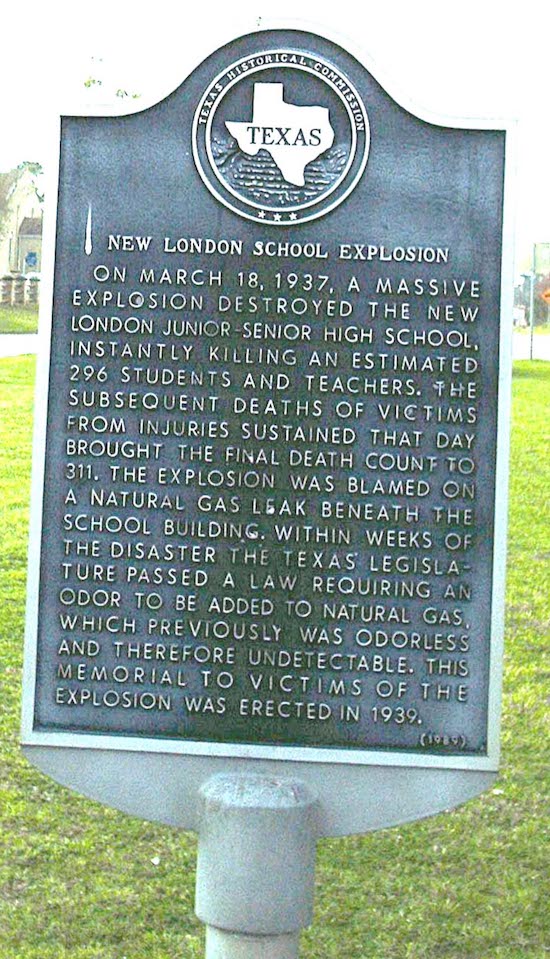
Photo (E. Goldberg,2005): Cenotaph Commemorates Memory of Those Who Died in School Blast March 18, 1937  http://www.newlondonschool.org/Cenotaph.htm

May 25, 2012


The cenotaph to the victims of the 1937 Texas School Explosion.
Gone at 317 YouTubeVideo 
The75th Anniversary of the opening of the Mother Frances Hospital. It opened a day earlier than planned to take care of many hurt children from the March 18 1937 New London school explosion.  David Brown, author, and Jimmie Robinson, survivor interviewed.
Jimmie Robinson, Survivor
Author, David Brown

March 01, 2012

Healthy Schools Heroes 2012: Champions for School Quality and Safety  

Every year to mark the anniversary of the March 18, 1937 Texas School Explosion, I salute a Healthy Schools Hero whose inspirational leadership sets a high standard for safety that protects children from hazards and unhealthy school conditions.


The Healthy Schools Hero award is part of a campaign to make March 18 an annual day to bring the lessons of the 1937 Texas School Explosion to every school, to update school values and technical skills for 21st century citizens, and to celebrate the leadership for safety that can save lives.  

This year, on the 75th anniversary of the tragedy, two school leaders from small Texas towns are Healthy Schools Heroes because each demonstrates extraordinary personal responsibility in making safety a core value and taking pride in schools that are clean and in good repair. 

They both understand that high standards, regulations, and professional training are essential safeguards for ensuring the quality and well-being of their communities.  
Harold Cowley

Both school leaders know the story of the 1937 New London School Explosion. They take no short cuts when it comes to safety.   

Superintendent Harold Cowley of Yantis ISD is a 2012 Healthy Kids Healthy Schools Hero for his extraordinary leadership and dedication to the safety and well-being of the children and teachers in Yantis, TX. Superintendent Cowley is highly qualified to be chief administrator of a modern school system because of a special combination of his values as well as his technical knowledge and skills.  READ MORE

Disa Schulze
We Make Decisions Based on Health and Safety  

Disa Schulze,
Director of Support Services, Danbury ISD, TX, is a 2012 Healthy Kids Healthy Schools Hero for more than twenty years of dedication to the safety and well-being of the children and teachers where she is responsible for Maintenance, Food Service, Transportation, and Safety.  READ MORE 


A Case Study and Cautionary Tale

The 1937 Texas School Explosion was a gas explosion that killed more than 300 people, mostly students, just minutes before the end of the day in their new state-of-the-art public school.


An investigation found unnecessary short cuts and false economies, a series of design, building and operations defects, and unheeded warnings. However, the investigators concluded that school officials were just "average individuals, ignorant or indifferent to the need for precautionary measures, where they cannot, in their lack of knowledge, visualize a danger or a hazard." (Court of Inquiry, 1937.)

A new law was quickly passed to require a warning odor in natural gas, thus saving millions of lives all over the world.  Yet, other important recommendations for safety are still too rare in today’s schools. They include requiring “technically trained administrators for modern school systems, rigid inspections and more widespread public education about managing hazards, and a comprehensive, rational safety code.”  

On March 25, 1937 fifth grader Carolyn Jones spoke to the Texas Legislature asking them "...to set aside a special day each year to be observed as a memorial day on which tribute will be paid to the children and teachers who died in this catastrophe...and to make laws of safety... Our daddies and mothers, as well as the teachers, want to know that when we leave our homes in the morning to go to school, that we will come out safe when our lessons are over."  Read Carolyn’s speech.

Read about Healthy Schools Heroes 2011 - 2005

Bring the Lessons of the 1937 TX School Explosion to Your School