March 12, 2010

Set aside a special day each year as a memorial....


...let us suggest the legislature of Texas set aside a special day each year to be observed as a memorial day on which tribute will be paid to the children and teachers who died in this catastrophe...and to make laws of safety... Our daddies and mothers, as well as the teachers, want to know that when we leave our homes in the morning to go to school, that we will come out safe when our lessons are over.
At the 2005 reunion of the New London School Explosion families, Carolyn Jones Frei reads the March 25, 1937 speech she gave as fifth grader Carolyn Jones to the Texas Legislature. She is standing in a corner of the London Museum being recorded by filmmaker Reva Goldberg. At her side is the machine that adds mercaptan, the warning smell to natural gas.
Complete Transcript

Mr. President, members of the house of representatives, and friends of school children, I’m here today as a representative of the London school and as a survivor of the school explosion that took the lives of nearly 500 pupils, teachers, and parents.

Last Thursday afternoon while my colleague and I were studying spelling for the interscholastic meet in which we were going to represent our school the next day, our teacher Mrs. Sory saw some pictures fall from the wall and several vases crash from the desk.

In an instant she had jerked open two nearby windows and said get out of here. We were clinging to her when we heard the first awful rumble that in a few seconds caused the room to collapse.

Mrs. Sory helped us out of the window and in another few seconds we were separated by the dark cloud of dust that blinded us.

When it got so I could see again I ran home as fast as I could. My teacher and friend were not killed, but I did not see them again.

My sister Helen Jones, an honor student and member of the high school champion debate team, was not so fortunate. She and my uncle, Paul Grier, a senior who planned to study medicine, were both taken from us in this awful explosion that killed so many of the future generation of East Texas.

When the announcement was made a few hours earlier by our principle that school would be dismissed for the county meet, the usual joy and excitement of a holiday prevailed. Little did we realize that we soon would be searching in the ruins of our beautiful school building for the bodies of our sisters and brothers and teachers.

First, as a representative of these school friends and teachers of mine, both living and dead, I am here today to express our appreciation for all that you and our governor have done for the relief of the suffering people of this community.

Second, let us suggest the legislature of Texas set aside a special day each year to be observed as a memorial day on which tribute will be paid to the children and teachers who died in this catastrophe.

We want to thank you for the memorial fund to which many of you have already contributed and which people all over the world are sending donations. We believe if those students and teachers who died would speak they would want a living memorial instead of a stately building.

By all means, we should have an appropriate but simple structure on which will appear the names of each pupil, teacher, and parent who died. With the remaining portion of money, our teachers suggest an endowment fund, to be used for the future education for the surviving children so that each might be assured of a college education if they so desired.

In conclusion, let me urge you, our lawmaking body, to make laws of safety, so it will not be possible for another explosion of this type to occur in the history of Texas schools.

Our daddies and mothers, as well as the teachers, want to know that when we leave our homes in the morning to go to school, that we will come out safe when our lessons are over.

Out of this explosion, we have learned of a new hazard that hovers about some of our school buildings. If this hazard can be forever blotted out of existence then we will not have completely lost our loved ones in vain.

We need say nothing more on the point of safety legislation because we as children of London school know that our faith in our government will not be betrayed. We will have safe school buildings in the future.

All of us who were spared will try to show our appreciation by striving to become the finest of citizens to carry on the work of this wonderful land of yours and mine.

This is our plea, thank you.

... As a result of the New London tragedy, the 45th Legislature enacted House Bill 1017 which amended Article 6053, Texas Revised Civil Statutes, 1925, giving the Railroad Commission the authority to adopt rules and regulations pertaining to the odorization of natural gas or liquefied petroleum gases. On July 27, 1937, Gas Utilities Docket 122 was adopted and the Commission began enforcement of odorization requirements for natural gas. 

March 11, 2010

COLD MORNING, 1937 and Memory Book

COLD MORNING, 1937

The night of the disaster, no one slept.
Sirens ripped the darkness with doom.
Dogs howled back. After the bodies
were found, we tried sleep,
stared at the ceiling, fixed by memories
we could never escape or soon describe.

Exhaustion loosened our grip on consciousness,
we slipped into a dark pool, lay floating
face down below the surface, until
the gray pool merged with gray dawn.

We rose, forcing our leaden feet
to the terrible task: caskets, the unctuous
minister, the exhausted emergency worker.

In a garage beside the mortuary,
makeshift tables held the remnants of lives,
shrouded in bloody sheets.

Rituals were omitted.  No neighbors stood
in doorways bearing plates of cake.
Those not bereaved avoided our eyes,
terrible as gorgons.

Yesterday's March morning warmed
to the trills of mockingbirds. Gulf breezes
rushing inland tossed new bluebonnets.
Today is a cottonmouth under a cold stone.

-- Carolyn Jones Frei


MEMORY BOOK

One muggy afternoon the students sat
for their last school pictures.  In the air
from the photographer's fan
the children's hair blows to the left.

When I open the Memory Book,
dead schoolmates assume weight,
dimension.  The faculty comes first
in death, knowing, dignified,
The school secretary wears a secret
smile, planning the wedding
that never came. Seniors parade
in caps and gowns, diplomas
never signed.  On the yellowing
pages for primary school, wisps
of hair slip from clips and ribbons,
bangs hang unevenly.

The names are regional: Iva Jo,
Sybil, Glendell, Lataine. Boys in
their fathers ties never inherited
their names. From freckled faces
clear eyes gaze, searching fate
in the camera's lens, composing
historic ovals memorized
by grieving parents.

Billy wears his skullcap, chin up,
feisty as always. Tall Ollie is shy.
The twins are separate on the page,
though never in life or death. The best
dressed girl wears her best dress.

They know the final mystery.
But we who survive memorialize
the pain, the loss of trust, another
slaughter of the innocents.

-- Carolyn Jones Frei

March 07, 2010


Vignette # 1 –Toxic Inhalation Hazard & Corrosive Chlorine Gas – Risk Factor 4
 
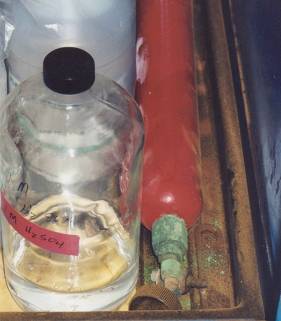
The lecture bottle (small gas cylinder) in the left photo was found in a high school corrosive storage cabinet.  The cylinder was unlabeled and none of the current teachers knew what it contained.  The corrosive vapors from a leaking bottle of sulfuric acid had seriously damaged the valve.  The teacher said she had considered cracking the valve and bleeding out a little gas to see if she could determine what it was by the smell but had thought better of it.  Fortunately, a former chemistry teacher was substitute teaching that day in a nearby room. When asked about the cylinder, he said, “Oh yeah, I know what that is.  It’s just chlorine.”

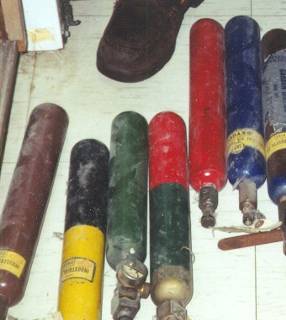
The lecture bottles on the right were from another school.  The red cylinder has the word “Chlorine” hand written on it in grease pencil.  None of the teachers knew these cylinders were stored in a box in a hidden shelf in the chemistry storage room.  In both cases, no one had the faintest idea of how to dispose of them, nor were they aware of the need to get them off their property as soon as possible.

In both cases, once I explained that there was sufficient pure chlorine gas in a full lecture bottle to be immediately life threatening to 100,000 people if distributed evenly, the schools were immediately in agreement that those gas cylinders needed to be removed and properly disposed as fast as possible.

What lessons can we pull from these two stories of unneeded toxic gases?
  • With no specific information on the hazards posed by chemicals, there is little motivation to dispose of them as long as they aren’t interfering in the daily routine.
  • When people gain perspective on the risks their chemicals pose to themselves and the students at their school, they are more willing to dispose of unneeded hazardous compounds.
  • When the photograph of the chlorine cylinder on the left was shown to the manager of our hazardous waste inspection program, our agency immediately determined these old school chemicals were a priority issue for us to tackle.  This led to a shift in funding to allow our program to help offset school cleanouts and the assignment of some of our field inspectors to tackle this problem.
Vignette #2: Toxic & Oxidizing Lead Nitrate – Risk Factor 3

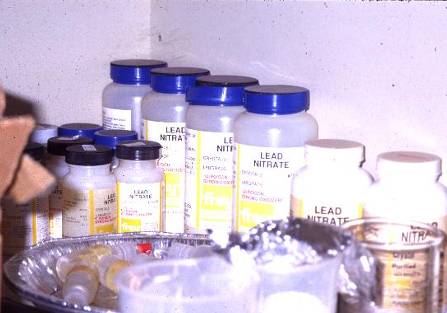
A middle school in Washington State had over 500 containers of lab chemicals, including 13 pounds of lead nitrate, in their science stockroom.  Lead nitrate is a poisonous oxidizer that is often used in dilute solutions and reacted with other chemicals to create colorful precipitates.

I asked the teacher if he used the lead nitrate.  

“Oh yeah, don’t get rid of that stuff, I need it.” 

“How much do you use?,” I asked.  

“Well, let’s see, I use one gram each quarter in the double displacement lab, and another gram a year in the flame test.”  

“OK,” I said, “then that’s about five grams a year, right?”  

“Yeah, that sounds right.”  

“Well then, with 454 grams in a pound, that means it’ll take you 90 years to use up one pound.  And with 13 pounds in stock, you’ve got about a 1,200 year supply on hand.  How long are you planning on teaching?”  

He laughed and agreed that he could probably get rid of some.  By the end of the discussion, he kept the newest container and set aside the other 12 pounds for disposal as hazardous waste.  

And, most importantly, he was then willing to dispose of another 150 pounds of hazardous chemicals that were on his shelves without feeling threatened that I was there to get rid of his needed chemicals.

What lessons can we pull from this typical story of too many bottles in storage?
  • They may need the chemical, but it doesn’t mean they need all they have.
  • A skilled inspector, asking probing questions in a non threatening way, can help a science teacher look at their chemicals in a new way.
  • When people gain perspective on the risks their chemicals pose to themselves and the students at their school, they are more willing to dispose of unneeded hazardous compounds.
  • The lab experiments that use this chemical are typically only taught in high-school-level chemistry classes.
Vignette #3: Corrosive Hydrofluoric Acid – Risk Factor 4

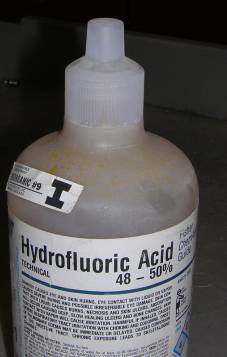
While dissolving minerals in a geology process laboratory, a technician spilled less than half a pint of  hydrofluoric acid (HF) onto his lap, splashing both thighs. The only protective equipment worn were chemical-resistant gloves.
He received chemical burns to nine percent of his body despite washing his legs with water from a hose at 1.5 gallons per minute. His contaminated clothing was not removed during the flushing process. Following flushing, the technician immersed himself in a chlorinated swimming pool for 40 minutes before an ambulance arrived. He became unconscious soon after arriving at a nearby hospital and his condition continued to deteriorate despite their best efforts.  His right leg was amputated seven days after the exposure and he died eight days later.

Investigators said he should have been wearing full length PVC coveralls with sleeves to the wrist, a face shield, rubber boots, safety goggles and mid-arm length PVC gloves while working with HF in a fume hood.  Calcium gluconate gel should have been nearby for immediate application on any exposed skin surface before the acid could penetrate the skin.

From this report  you can see why hydrofluoric acid (HF) is considered dangerous; it’s very toxic and readily passes into the bloodstream through exposed skin, a potent combination of risk factors. The fluorine ion in HF preferentially binds with calcium. Spilled HF acts as an anesthetic as it passes through the skin into the bloodstream where it quickly begins to dissolve bones and cause systemic poisoning. This is why HF is considered the highest risk acid in schools. Other acids may be corrosive but they do not contain this additional secondary effect that increases their risk.

As you may have guessed, no secondary school in the United States has safety gear or spill supplies available that resemble the recommended personal protective equipment described in the anecdote.

Both art classes and science classes can include classroom activities that use HF.  Though most science teachers are willing to eliminate their collection of old HF containers, that’s often  not the case with art teachers.  Why would an art teacher argue to keep their HF paste?  Because it has been used by artists for years in stained glass and other glass-etching techniques.

HF dissolves glass on contact, releasing harmful fumes, as described by Arthur Duthie in 1908 in Decorative Glass Processes. "The fumes escape from full strength acid so profusely as to be quite visible like a yellow smoke, and are not only obnoxious, but dangerous. Even at moderate working strength they will cause bleeding of the throat and nostrils in persons in whom these organs happen to be weak, while they commonly cause severe smarting of the eyes..."

Vignette # 4: Pyrophoric White and Yellow Phosphorus – Risk Factor 4

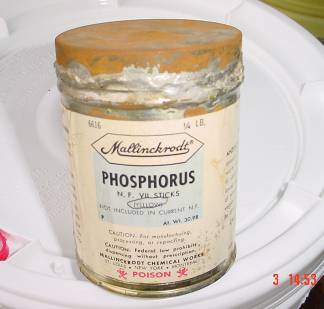
White phosphorus is pyrophoric, as is yellow phosphorus, which means they spontaneously ignite in contact with air.  Pure phosphorus is highly toxic and should be stored under water.

The Canning Jar on the left has a large amount of white phosphorus which, over time, has reacted make the water acidic and corroded the container’s lid.  This has allowed water evaporate over time and lower the water level to a quarter-inch above the top of the phosphorus sticks.  If the water layer lowered even slightly, the risk of spontaneous combustion are very high.

The teacher said he needed to keep it, because he used it in a lab.  Turned out that all he did was cut off  a piece, take it outside and drop it on the pavement where it released poisonous smoke and burned a hole in the asphalt.  Unlike him, I was unconvinced that this was “good science.”

Why would a middle school science teacher have this much white phosphorus, and why would he try to convince me that he needed to keep it?  

Upon reflection, I think there were three reasons:

  • Teenagers have poor attention spans, so having something spontaneously ignite looks “cool” and may get them to pay attention to what’s going on, if only for a minute or two.
  • The teacher didn’t notice that the water level had dropped and didn’t think about the consequences of the container’s contents spontaneously igniting on top of the wooden shelf in his stockroom filled with chemicals.
  • The teacher had been around for a long time and had become fond of his more esoteric chemicals and didn’t want to see them go.  Like me, he liked the chance to tell some “chemical war stories” and phosphorus is much more lively a focus than baking soda.
Vignette #5: Water Reactive & Peroxidizable Elemental Potassium – Risk Factor 4
   

Potassium metal is highly water-reactive.  Though not commonly found in schools, science teachers use it to demonstrate the properties of the alkali metals.  First a piece of lithium is dropped in water and fizzes.  Then a piece of sodium metal is dropped on the water, where it turns into a molten ball that dances across the surface, fizzing loudly.  When potassium is dropped added, it zings around the surface of the water with purple flames shooting into the air above it.

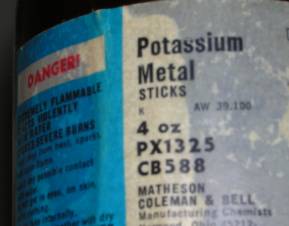
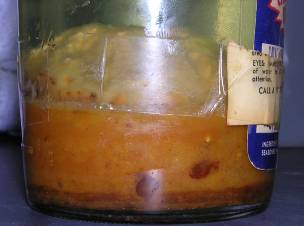
Potassium is sold as silver-gray sticks of soft metal under kerosene or mineral oil to keep moisture away.  It reacts with the air; first to form white potassium hydroxide crystals.  After time has passed, the reaction continues and forms potentially explosive peroxide crystals.  Peroxidized potassium, seen above in the photo on the right, is characterized by orange, red or purple crystals.

Peroxidized potassium was found in the same middle school stockroom as the white phosphorus shown earlier.  The teacher was unconvinced when I said the container must be disposed, saying “I can use it, I’ll just scrape off the orange stuff.”  I pointed out that the act of scraping could start a chain reaction that would cause the entire chunk to detonate.  He still persisted in saying he needed it.  Finally I said “Look, if you do that, it could blow your hands off.”  As if snapping out of a hypnotic state, he looked up and went “Oh!, Well then. Maybe I can just use the newer jar over here instead.”  After three days of treatment and $6,000 in fees, the stabilized material was disposed as hazardous waste.

March 06, 2010

Schools still are making the same mistakes...

From the Editor, Column, American School Board Journal>>, Glenn Cook, Editor-in-Chief, April, 2008.  

Having grown up on the Texas Gulf Coast, I know a little about disasters, natural and man made. Galveston County, where I was raised, is home to the two worst disasters in Texas history -- the 1900 hurricane and the 1947 explosion that rocked my hometown of Texas City. Yes, it's a somewhat dubious distinction, but a definite conversation starter.  And now, in a photo essay on Page 44, it's time to look back at number three on the list.

The March 18, 1937, explosion of the London School in New London, Texas, is the worst school disaster in U.S. history. More than 300 people were killed in a blast that, by all rights and reason, could have been avoided.  Seventy-one years later, the survivors still bear the emotional and physical scars from that day. And 71 years later, schools still are making the same mistakes in terms of how they keep chemicals safely away from children.

..."Time to Heal>>" is both a slice of history and a cautionary tale for school leaders. Read it and appreciate what the survivors have lived with for more than seven decades, then go and ask questions about your district's chemical safety plans. You'll be glad you did. 

March 05, 2010

Ensure that no one is ever injured...

Two years after retiring from active laboratory safety activities and upon leaving the lab safety discussion list, Dave Andrews wrote the following reminder to his colleagues:

"Fellow laboratory safety specialists: As we part company, I feel I must, for one final time, remind each of you in an academic setting that the lessons that you teach in your classes and your labs will be the habits that your charges will carry forward into industry.

If you teach safety and then allow other than 100% compliance with safe work practices in your laboratory spaces, your charges will go forth from your classes and routinely bypass safety rules and you may, one day, wonder why one of your smartest students died in a laboratory accident.

Make sure every rule in your laboratory is based on sound science and then enforce them 100% of the time for every student – and, most important, for your own work in the laboratory.

Make sure your students know that laboratory clothing and safety equipment makes no fashion statement, but is required for entrance into the lab.  Do not allow any laboratory activity to proceed without a procedure.  Remember that legal requirements are the absolute minimum you must do in your lab – the rules in your lab must be based on what is necessary to ensure that no one is ever injured by the activities conducted in your laboratories and that no one outside your laboratories has any exposure to any of the chemicals within your labs."

(Dave's response to my request for permission to reprint his words:  “Of course!  My goal is now, and has been, doing whatever is necessary to protect the American worker – especially when working with hazardous chemicals.  If these words will save one burnt finger, then they are well worth posting.  You have my permission to use them in any way you determine to be useful." Dave Andrews, 3/13/09)

Addition words of wisdom from Dave:

·         If your management cannot/will not support safety in your lab – QUIT – the job is not worth the potential grief and guilt that awaits you!

·         If you knew an employee (student) was going to have an accident in the lab tomorrow, would you be willing to fire them(remove them) today?

·         Students entering a laboratory training program should have an entrance project to research rule, prudent practices, and injury reports and develop a set of safety rules for the lab – this will grant ownership of the rules to the students.  This is not an easy job for you!

·         Safety glasses are for when no activities are going on in the laboratory – when chemicals are being used, goggles are a minimum – face shields are not eye protection – safety glasses or goggles must be worn when using a face shield.

·         Personal protective clothing is not impervious to hazardous chemicals – their only intended function is to provide reaction time – If you get splashed with chemicals , the job stops, the PPC comes off, and corrective measure begin.

·         All severely hazardous chemical splashes require use of the safety shower and removal of affected clothing – No she cannot go down to the locker room and shower there!!!

·         Compliance with applicable regulations cannot be a goal – they are a requirement for operations – the absolute minimum necessary.  You must evaluate ALL the hazards and select protective measure that will always protect the student.

·         Every injury, splash(even if no injury) or other incident in the laboratory requires evaluation and either changing the rules, increasing the frequency and intensity of training or discipline.  (Oh, and discipline is not the real answer – as all incidents are a direct result of inadequate management!)
-- Dave Andrews, CHMM (now expired)
  • Radiation Safety Officer and manager safety, health and Environment at one of the largest contract non-clinical laboratories in the world.  
  • Consultant/Instructor, Environmental & Occupational Consulting and Training, Inc
  • Instructor, Chemistry, Safety, Radiation Safety, and Environmental at a Nuclear Electric Generation plant
  • All of that without so much as a formal semester of college training, though I did take and pass (3.5) a post graduate level Toxicology class.

March 04, 2010

You can prevent explosions in your school.

Help make chemical safety part of your school's ongoing security audits and safety plan.

1) Talk with parents, educators and community leaders about making safety part of school culture.  Does everyone feel safe speaking up?  Don't go it alone. Find allies. If school staff or other parents are fearful or unresponsive, keep reaching out to others. Contact your local or state public health department, your local fire/life safety team, homeland security office or emergency preparedness center.  Your persistence could save lives.

2) Bring the Lessons to Your School Make safety part of the curriculum in science education, vocational education, occupational health and safety, community service, comprehensive school health and injury prevention, school security, emergency preparedness, environmental education, civic education, school maintenance, and operations.

3) Promote a sense of shared responsibility and accountability for student, employee and visitor health and safety in all school areas and activities. Does everyone feel "ownership" for a safe school?  

See Leadership Needed. What opportunities for leadership exist in your school?  Use these resources to update your school's values and technical skills for 21st century citizens. 
  • Least-toxic chemistry labs This collection of fully-scripted, least-toxic chemistry labs is ready for use by high school chemistry teachers.  The set includes student and teacher guides and meets the Washington State Educational Learning Requirements