Showing posts with label unsafe schools. Show all posts

September 21, 2010

Teaching Safely, Teaching Safety

Information and Tools

Laboratory Self-Audit: Setting Up Your Audit
Classrooms and laboratories practicing pollution prevention are safer for students and in most cases easier on the school budget besides being fairly easy to implement. However, changes in thinking must occur to make the initial effort a success. Lay the groundwork for change before using the Self-Audit Checklists included in this resource. Start with some basic grassroots organizing using these suggestions or some of the many community development resources available. The result will be a program that works for your school community.  Read more

Checklists
Posters

March 11, 2010

COLD MORNING, 1937 and Memory Book

COLD MORNING, 1937

The night of the disaster, no one slept.
Sirens ripped the darkness with doom.
Dogs howled back. After the bodies
were found, we tried sleep,
stared at the ceiling, fixed by memories
we could never escape or soon describe.

Exhaustion loosened our grip on consciousness,
we slipped into a dark pool, lay floating
face down below the surface, until
the gray pool merged with gray dawn.

We rose, forcing our leaden feet
to the terrible task: caskets, the unctuous
minister, the exhausted emergency worker.

In a garage beside the mortuary,
makeshift tables held the remnants of lives,
shrouded in bloody sheets.

Rituals were omitted.  No neighbors stood
in doorways bearing plates of cake.
Those not bereaved avoided our eyes,
terrible as gorgons.

Yesterday's March morning warmed
to the trills of mockingbirds. Gulf breezes
rushing inland tossed new bluebonnets.
Today is a cottonmouth under a cold stone.

-- Carolyn Jones Frei


MEMORY BOOK

One muggy afternoon the students sat
for their last school pictures.  In the air
from the photographer's fan
the children's hair blows to the left.

When I open the Memory Book,
dead schoolmates assume weight,
dimension.  The faculty comes first
in death, knowing, dignified,
The school secretary wears a secret
smile, planning the wedding
that never came. Seniors parade
in caps and gowns, diplomas
never signed.  On the yellowing
pages for primary school, wisps
of hair slip from clips and ribbons,
bangs hang unevenly.

The names are regional: Iva Jo,
Sybil, Glendell, Lataine. Boys in
their fathers ties never inherited
their names. From freckled faces
clear eyes gaze, searching fate
in the camera's lens, composing
historic ovals memorized
by grieving parents.

Billy wears his skullcap, chin up,
feisty as always. Tall Ollie is shy.
The twins are separate on the page,
though never in life or death. The best
dressed girl wears her best dress.

They know the final mystery.
But we who survive memorialize
the pain, the loss of trust, another
slaughter of the innocents.

-- Carolyn Jones Frei

March 07, 2010


Vignette # 1 –Toxic Inhalation Hazard & Corrosive Chlorine Gas – Risk Factor 4
 
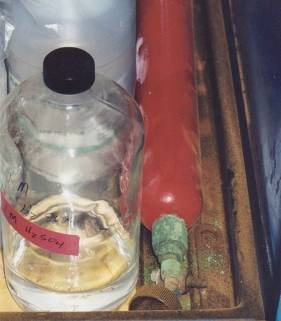
The lecture bottle (small gas cylinder) in the left photo was found in a high school corrosive storage cabinet.  The cylinder was unlabeled and none of the current teachers knew what it contained.  The corrosive vapors from a leaking bottle of sulfuric acid had seriously damaged the valve.  The teacher said she had considered cracking the valve and bleeding out a little gas to see if she could determine what it was by the smell but had thought better of it.  Fortunately, a former chemistry teacher was substitute teaching that day in a nearby room. When asked about the cylinder, he said, “Oh yeah, I know what that is.  It’s just chlorine.”

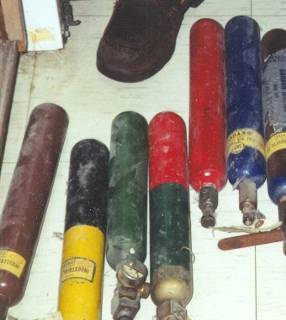
The lecture bottles on the right were from another school.  The red cylinder has the word “Chlorine” hand written on it in grease pencil.  None of the teachers knew these cylinders were stored in a box in a hidden shelf in the chemistry storage room.  In both cases, no one had the faintest idea of how to dispose of them, nor were they aware of the need to get them off their property as soon as possible.

In both cases, once I explained that there was sufficient pure chlorine gas in a full lecture bottle to be immediately life threatening to 100,000 people if distributed evenly, the schools were immediately in agreement that those gas cylinders needed to be removed and properly disposed as fast as possible.

What lessons can we pull from these two stories of unneeded toxic gases?
  • With no specific information on the hazards posed by chemicals, there is little motivation to dispose of them as long as they aren’t interfering in the daily routine.
  • When people gain perspective on the risks their chemicals pose to themselves and the students at their school, they are more willing to dispose of unneeded hazardous compounds.
  • When the photograph of the chlorine cylinder on the left was shown to the manager of our hazardous waste inspection program, our agency immediately determined these old school chemicals were a priority issue for us to tackle.  This led to a shift in funding to allow our program to help offset school cleanouts and the assignment of some of our field inspectors to tackle this problem.
Vignette #2: Toxic & Oxidizing Lead Nitrate – Risk Factor 3

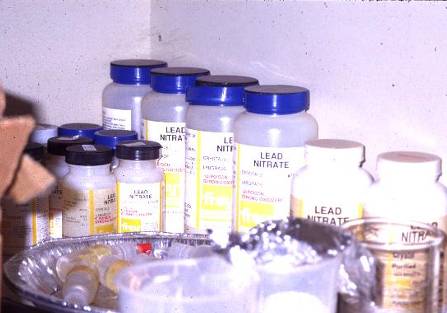
A middle school in Washington State had over 500 containers of lab chemicals, including 13 pounds of lead nitrate, in their science stockroom.  Lead nitrate is a poisonous oxidizer that is often used in dilute solutions and reacted with other chemicals to create colorful precipitates.

I asked the teacher if he used the lead nitrate.  

“Oh yeah, don’t get rid of that stuff, I need it.” 

“How much do you use?,” I asked.  

“Well, let’s see, I use one gram each quarter in the double displacement lab, and another gram a year in the flame test.”  

“OK,” I said, “then that’s about five grams a year, right?”  

“Yeah, that sounds right.”  

“Well then, with 454 grams in a pound, that means it’ll take you 90 years to use up one pound.  And with 13 pounds in stock, you’ve got about a 1,200 year supply on hand.  How long are you planning on teaching?”  

He laughed and agreed that he could probably get rid of some.  By the end of the discussion, he kept the newest container and set aside the other 12 pounds for disposal as hazardous waste.  

And, most importantly, he was then willing to dispose of another 150 pounds of hazardous chemicals that were on his shelves without feeling threatened that I was there to get rid of his needed chemicals.

What lessons can we pull from this typical story of too many bottles in storage?
  • They may need the chemical, but it doesn’t mean they need all they have.
  • A skilled inspector, asking probing questions in a non threatening way, can help a science teacher look at their chemicals in a new way.
  • When people gain perspective on the risks their chemicals pose to themselves and the students at their school, they are more willing to dispose of unneeded hazardous compounds.
  • The lab experiments that use this chemical are typically only taught in high-school-level chemistry classes.
Vignette #3: Corrosive Hydrofluoric Acid – Risk Factor 4

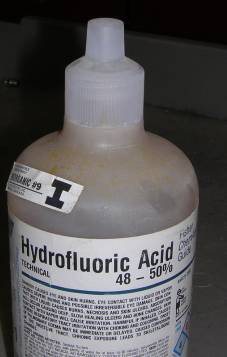
While dissolving minerals in a geology process laboratory, a technician spilled less than half a pint of  hydrofluoric acid (HF) onto his lap, splashing both thighs. The only protective equipment worn were chemical-resistant gloves.
He received chemical burns to nine percent of his body despite washing his legs with water from a hose at 1.5 gallons per minute. His contaminated clothing was not removed during the flushing process. Following flushing, the technician immersed himself in a chlorinated swimming pool for 40 minutes before an ambulance arrived. He became unconscious soon after arriving at a nearby hospital and his condition continued to deteriorate despite their best efforts.  His right leg was amputated seven days after the exposure and he died eight days later.

Investigators said he should have been wearing full length PVC coveralls with sleeves to the wrist, a face shield, rubber boots, safety goggles and mid-arm length PVC gloves while working with HF in a fume hood.  Calcium gluconate gel should have been nearby for immediate application on any exposed skin surface before the acid could penetrate the skin.

From this report  you can see why hydrofluoric acid (HF) is considered dangerous; it’s very toxic and readily passes into the bloodstream through exposed skin, a potent combination of risk factors. The fluorine ion in HF preferentially binds with calcium. Spilled HF acts as an anesthetic as it passes through the skin into the bloodstream where it quickly begins to dissolve bones and cause systemic poisoning. This is why HF is considered the highest risk acid in schools. Other acids may be corrosive but they do not contain this additional secondary effect that increases their risk.

As you may have guessed, no secondary school in the United States has safety gear or spill supplies available that resemble the recommended personal protective equipment described in the anecdote.

Both art classes and science classes can include classroom activities that use HF.  Though most science teachers are willing to eliminate their collection of old HF containers, that’s often  not the case with art teachers.  Why would an art teacher argue to keep their HF paste?  Because it has been used by artists for years in stained glass and other glass-etching techniques.

HF dissolves glass on contact, releasing harmful fumes, as described by Arthur Duthie in 1908 in Decorative Glass Processes. "The fumes escape from full strength acid so profusely as to be quite visible like a yellow smoke, and are not only obnoxious, but dangerous. Even at moderate working strength they will cause bleeding of the throat and nostrils in persons in whom these organs happen to be weak, while they commonly cause severe smarting of the eyes..."

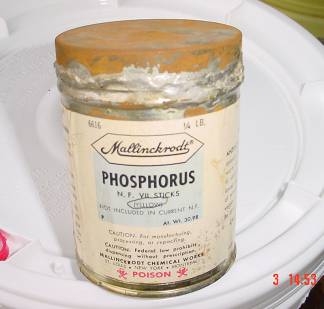
Vignette # 4: Pyrophoric White and Yellow Phosphorus – Risk Factor 4

White phosphorus is pyrophoric, as is yellow phosphorus, which means they spontaneously ignite in contact with air.  Pure phosphorus is highly toxic and should be stored under water.

The Canning Jar on the left has a large amount of white phosphorus which, over time, has reacted make the water acidic and corroded the container’s lid.  This has allowed water evaporate over time and lower the water level to a quarter-inch above the top of the phosphorus sticks.  If the water layer lowered even slightly, the risk of spontaneous combustion are very high.

The teacher said he needed to keep it, because he used it in a lab.  Turned out that all he did was cut off  a piece, take it outside and drop it on the pavement where it released poisonous smoke and burned a hole in the asphalt.  Unlike him, I was unconvinced that this was “good science.”

Why would a middle school science teacher have this much white phosphorus, and why would he try to convince me that he needed to keep it?  

Upon reflection, I think there were three reasons:

  • Teenagers have poor attention spans, so having something spontaneously ignite looks “cool” and may get them to pay attention to what’s going on, if only for a minute or two.
  • The teacher didn’t notice that the water level had dropped and didn’t think about the consequences of the container’s contents spontaneously igniting on top of the wooden shelf in his stockroom filled with chemicals.
  • The teacher had been around for a long time and had become fond of his more esoteric chemicals and didn’t want to see them go.  Like me, he liked the chance to tell some “chemical war stories” and phosphorus is much more lively a focus than baking soda.
Vignette #5: Water Reactive & Peroxidizable Elemental Potassium – Risk Factor 4
   

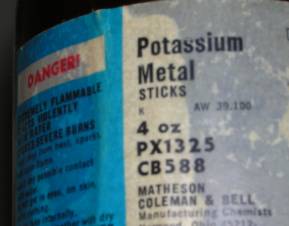
Potassium metal is highly water-reactive.  Though not commonly found in schools, science teachers use it to demonstrate the properties of the alkali metals.  First a piece of lithium is dropped in water and fizzes.  Then a piece of sodium metal is dropped on the water, where it turns into a molten ball that dances across the surface, fizzing loudly.  When potassium is dropped added, it zings around the surface of the water with purple flames shooting into the air above it.

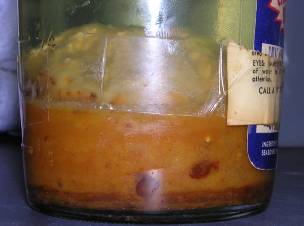
Potassium is sold as silver-gray sticks of soft metal under kerosene or mineral oil to keep moisture away.  It reacts with the air; first to form white potassium hydroxide crystals.  After time has passed, the reaction continues and forms potentially explosive peroxide crystals.  Peroxidized potassium, seen above in the photo on the right, is characterized by orange, red or purple crystals.

Peroxidized potassium was found in the same middle school stockroom as the white phosphorus shown earlier.  The teacher was unconvinced when I said the container must be disposed, saying “I can use it, I’ll just scrape off the orange stuff.”  I pointed out that the act of scraping could start a chain reaction that would cause the entire chunk to detonate.  He still persisted in saying he needed it.  Finally I said “Look, if you do that, it could blow your hands off.”  As if snapping out of a hypnotic state, he looked up and went “Oh!, Well then. Maybe I can just use the newer jar over here instead.”  After three days of treatment and $6,000 in fees, the stabilized material was disposed as hazardous waste.

March 06, 2010

Schools still are making the same mistakes...

From the Editor, Column, American School Board Journal>>, Glenn Cook, Editor-in-Chief, April, 2008.  

Having grown up on the Texas Gulf Coast, I know a little about disasters, natural and man made. Galveston County, where I was raised, is home to the two worst disasters in Texas history -- the 1900 hurricane and the 1947 explosion that rocked my hometown of Texas City. Yes, it's a somewhat dubious distinction, but a definite conversation starter.  And now, in a photo essay on Page 44, it's time to look back at number three on the list.

The March 18, 1937, explosion of the London School in New London, Texas, is the worst school disaster in U.S. history. More than 300 people were killed in a blast that, by all rights and reason, could have been avoided.  Seventy-one years later, the survivors still bear the emotional and physical scars from that day. And 71 years later, schools still are making the same mistakes in terms of how they keep chemicals safely away from children.

..."Time to Heal>>" is both a slice of history and a cautionary tale for school leaders. Read it and appreciate what the survivors have lived with for more than seven decades, then go and ask questions about your district's chemical safety plans. You'll be glad you did. 

March 03, 2010

Hazardous Materials in Schools:  A Hidden Problem

Excerpt from the article, Impediments to Implementing P2 in the Public Schools by Marina M. Brock

Environmental, health, and safety hazards in public schools are often serious — and difficult to address.

While interviewing a local fire prevention officer from one of our communities, I discovered that his major community concern regarding hazardous material was not what I believed it to be.  He removed from his cabinet a file that was about eight inches thick, and told me it was a written history of safety issues from our regional high school.  The file represented five years of effort to improve conditions that he felt were a problem.

Blinded by my own assumptions regarding our educational institutions, I didn’t believe him — but I humored him, wanting to get into his good graces.  We arranged an on-site interview at the high school, where I was sure I would be able to point out that the facility was not as much of a problem as his “untrained eye” could see.

Our first on-site interview was with the science supervisor, a 20-year veteran of high school science teaching.  While we were in his classroom discussing hazardous material management issues, a janitor worked quietly in the rear of the classroom sweeping the floor.  The science supervisor was pleased to tell us that he had been disposing of his “heavy metal acids” for years using the “Flynn Method,” by inerting them and pouring them into the sink, which connected to the “tight tank” outside his classroom.

I remember thinking to myself that the designers of the high school must have been incredible visionaries to have the forethought to install a tight tank in the early 1970s, when the facility was constructed.  Before I could ask about this, however, the heretofore silent janitor sheepishly mentioned that they didn’t have a “tight tank” at their school.  Obviously embarrassed, we all remained silent.  The “tight tank” mistake eventually resulted in a $55,000 environmental cleanup.

I soon discovered that my initial assumptions regarding the conditions at this school were grossly in error.  I was astounded at the lack of even a basic understanding regarding simple concepts of health, safety, and environmental compliance....

For the complete article go to Impediments to Implementing P2 in the Public Schools 

Marina M. Brock is a senior environmental specialist with the Barnstable County Department of Health and the Environment (BCDHE).  

Too often, administrators ask teachers to accept unsafe conditions

The introduction of a lab program into a high school is an expensive venture. Lab facilities and equipment require capital expenditures. The replenishment of supplies requires additional annual funds. In addition, safety requirements place limits on the number of students that can be properly supervised in a classroom. 

Too often, administrators ask teachers to accept unsafe conditions by packing too many students in the lab space. When teachers object, the administrator may suggest that we sacrifice the quality of teaching by not providing lab experiences at all. This Hobson's choice forces teachers to make a bad decision—unsafe conditions or poor instruction. 
In contrast, high schools across the United States support football teams that similarly require large expenditures for equipment and subscribe to required safety requirements. The football coach is never asked to use sub-standard helmets or to cancel play. High school science should not be considered less important than high school football.
  
Excerpts from comments by Dr. Arthur Eisenkraft, Distinguished Professor of Science Education; Director, Center of Science and Math in Context (COSMIC), University of Massachusetts, Boston, at the Hearing: Improving the Laboratory Experience for America's High School Students, before the Subcommittee on Research and Science Education Committee on Science and Technology, House of Representatives, 110th Congress, first session, March 8, 2007

March 01, 2010

The need is severe and immediate...

Bad air inside and outside schools escalate health care costs, increase absenteeism, and reduce test scores.  The new report from the National Healthy Schools Network, “Sick Schools 2009 ‐ America’s Continuing Environmental Health Crisis for Children” provides state by state assessments of the problems and opportunities for advocates.  Read more >>

Doreen Croser, Executive Director of American Association on Intellectual and Developmental Disabilities, a leader in advocating quality of life and rights for people with disabilities, said, “Students with intellectual and developmental disabilities need protection in America’s schools. Special education students are often more vulnerable to lead, pesticides, hazardous cleaning supplies and contaminated indoor air found in too many schools. An unhealthy school environment makes learning more challenging and staying healthy harder.”

Vernice Miller‐Travis, Vice‐Chair, Maryland State Commission on Environmental Justice and Sustainable Communities said, “The fact that the poorest, highest risk children have the schools in the worst condition has been a civil rights issue going back to Brown v. Education of Topeka in 1954. Today, we know even more: that the impacts from toxic school siting to lead in drinking water to mold infestations and to chemical spills are damaging millions of children every year, taking away their health and their chance for a productive future.”

Georges Benjamin, MD, FACP said "Unhealthy conditions in our schools lead to failing grades and failing health." Benjamin is executive director of the American Public Health Association. He added, "Environmental concerns such as asbestos, mold, poor air quality and other hazards affect children's ability to learn and their health, and schools in low‐income communities are often disproportionately affected. We must close this gap and ensure that all of our kids are given an opportunity to learn, grow and play in safe, healthy schools."

Bill Orr, Executive Director, Collaborative for High Performance Schools said, "The time has come to stop mortgaging our children's health in the name of the status quo. A truly high performance school does not just protect the environment, but makes the health and well‐being of schoolchildren and staff the top priority. EPA has shown the scientific evidence and importance of investing in healthy schools, and now Congress must take heed of its counsel."

* * * * * * * * * * 

Nurses afraid to speak up

WHAT SCHOOL NURSES KNOW: We Need New Laws to Clean Up Schools, 8 pp, results from survey of members from the NYS Association of School Nurses revealing that nurses fear job retaliation and many know students whose health and learning are affected by school environments (May, 2000).  Healthy Schools/Healthy Kids Clearinghouse

February 28, 2010

Odorization: simply a matter of safety

It has been almost seventy years since a tragic natural gas explosion occurred at a school building in New London, TX. This event opened the eyes of the community, the emerging natural gas industry, and the entire world.

Early in 1937, the New London school board, in order to save money, cancelled their natural gas contract. Instead, plumbers installed a tap into a residual gas line associated with oil production. This practice, while not explicitly authorized by local oil companies, was widespread in the area. The natural gas extracted with the oil was seen as a waste product and thus was flared off.

Natural gas, which is odorless and therefore undetectable to the human nose, had been leaking from the connection to the residual line. The gas had built up inside an enclosed crawlspace that ran the entire length of the school building. Students had been complaining of headaches for some time, but little attention was paid. 

For more go to Odorization: simply a matter of safety. (natural gas)(Brief article).  Pipeline & Gas Journal 233.11 (Nov 2006): p50(1).  http://www.oildompublishing.com/PGJ/pgjarchive/Nov06/Ordorization.pdf

January 15, 2010

Blackboard found in the rubble.

Wright Room 102  5 D   March 18, 1937  

     Oil and natural gas are east Texas’ greatest mineral blessing.  Without them this school would not be here and none of us would be here learning our lessons.